
Category Archives: Uncategorized

Strayan Rates – Part 4: Safe as a House

It was a sensible thing to do, after our forebears discovered that food could be summoned from the earth beneath their feet; rather than roam, they remained. And where they remained, they built shelter. As they settled down, they came to recognise their reliance on the vagaries of the weather; indeed there seemed to be something almost human-like in its caprices. And so great sacrifices were made to propitiate these vital but fearsome forces in the sky.

In outward appearance, houses are much evolved since the days of those sedentary pioneers, but the basic function is unchanged: to provide shelter from the elements. Well, almost unchanged. Advanced civilisation has managed to assign a second function to houses: wealth-generation. In some places, so powerful has this function become that an apotheosis of sorts has been realized for the once-humble abode, and we find ourselves appeasing this latter-day deity with all the enthusiasm of our trembling forebears.


No inquiry into the direction of Aussie interest rates would be close to complete without a look at the almighty housing sector, and the unique position it holds in the modern Australian economy.

So that’s what we have here.

For the 60 years or so between the 1890s depression and the post-war reconstruction/Korean wool boom of the 1950s, Australian housing was a pretty lousy bet, as illustrated in this chart from Philip Soos and Paul D. Egan.
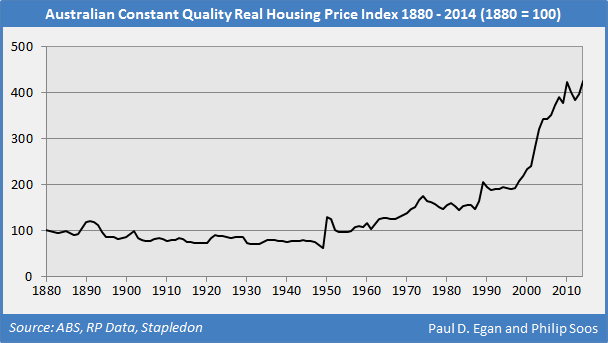
Philip_Soos_HP_03

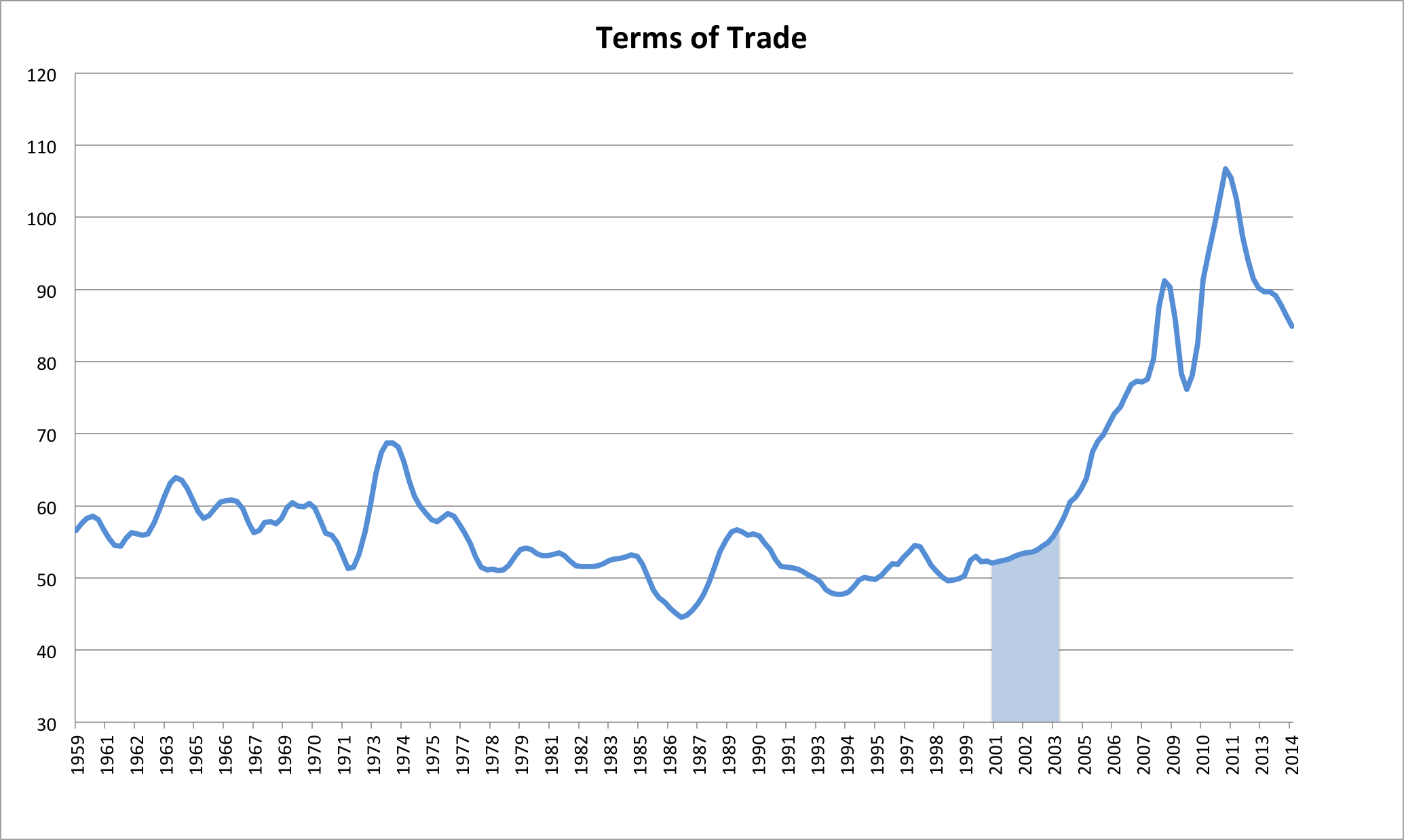
Even after the trend reversed with the post-war boom (see terms of trade chart for reference), house price growth through to the late 1990s largely tracked the long-term growth in per capita incomes. Then as the millennium approached, and despite plausible claims that confused computers would end civilization as we knew it, Australians learnt to stop worrying and love the abode.

Between 1997 and 2003, dwelling prices in Australia doubled, rising by an average of 13% per annum, far in excess of income growth. This therefore drove up the ratio of house prices to incomes, with the additional demand arriving by a surge of household borrowing. (See Bloxham, Kent, Robson, 2010 and RBA, 2003b for detailed discussion of the Australian housing sector.)
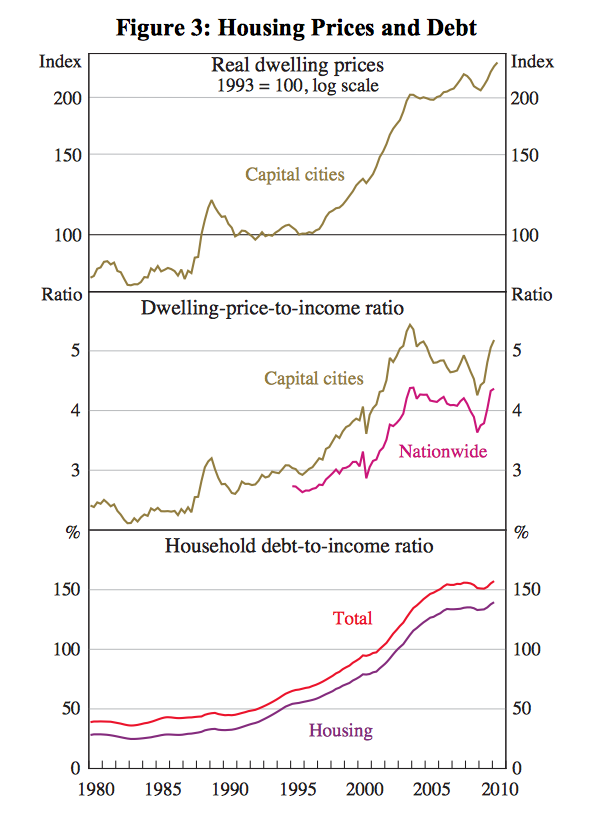
Screen Shot 2014-09-09 at 1.10.27 pm

There were a number of factors that propelled the housing market through this period, however the primary influence was a halving of interest rates over the decade to the late 1990s. Inflation stabilised at a low rate during the 1990s, after a sustained period of rapid, volatile increases in consumer prices. Lower inflation saw a decline in interest rates which made mortgages more accessible. Financial deregulation in the 1980s heightened competition amongst banks and other credit providers, which further reduced interest rates and increased the availability of credit to households.

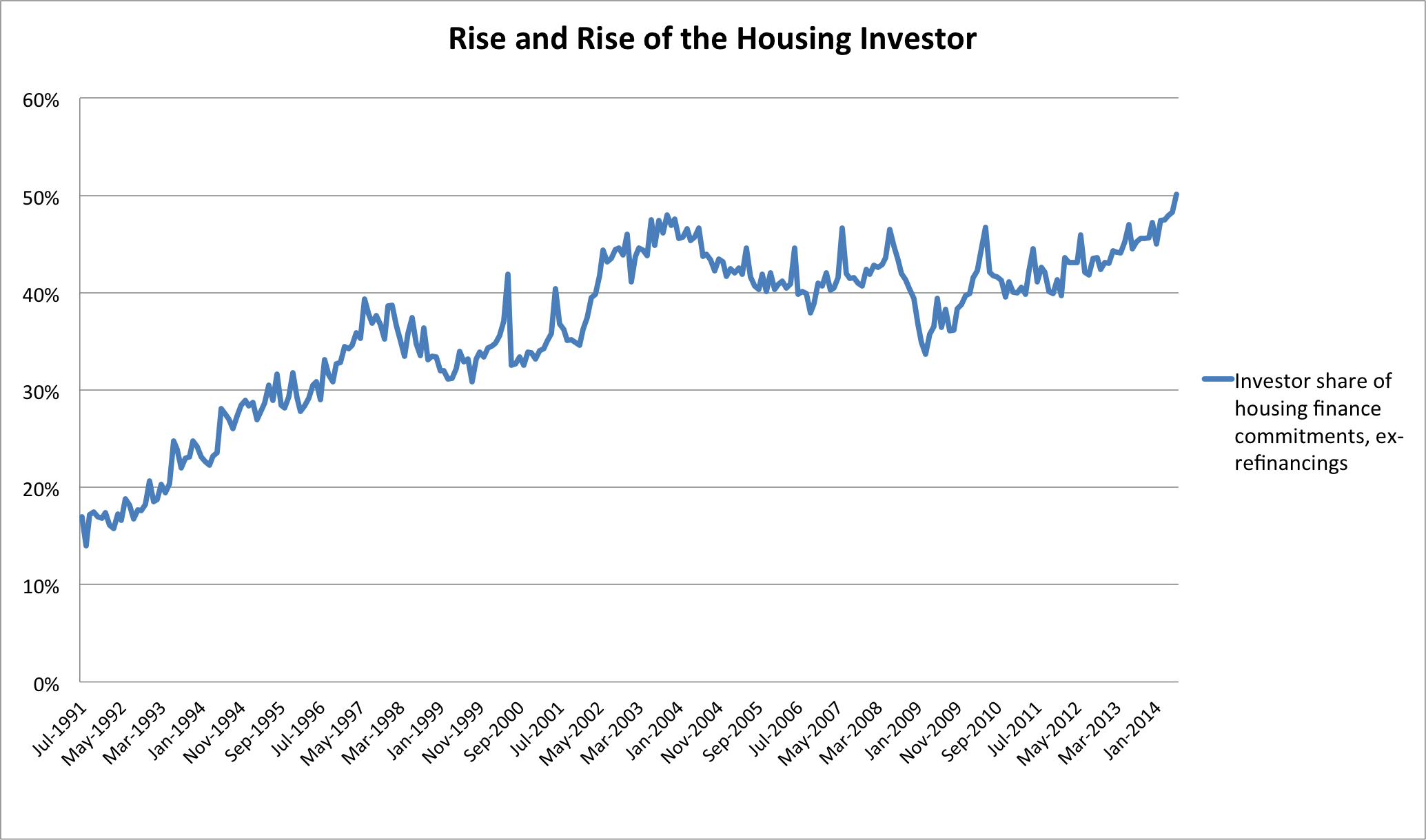
If easier access to credit ignited the boom, then structural supply constraints, government incentives and good old ‘animal spirits’ acted as the kerosene. The favourable tax treatment of property investments became particularly incendiary. In Australia, tax losses incurred on an investment property may be offset against other taxable income (the ever-controvesial ‘negative gearing’), meaning that regular cash outlays incurred through an investment property can be far below the actual costs (including mortgage interest payments). This in itself isn’t necessarily an irresistible attraction, however combined the strong appreciation in house prices in the late 1990s, it proved a potent mix. Egged on by a metastasising property investment seminar industry, the era of the Australia housing investor had dawned.
housing investor

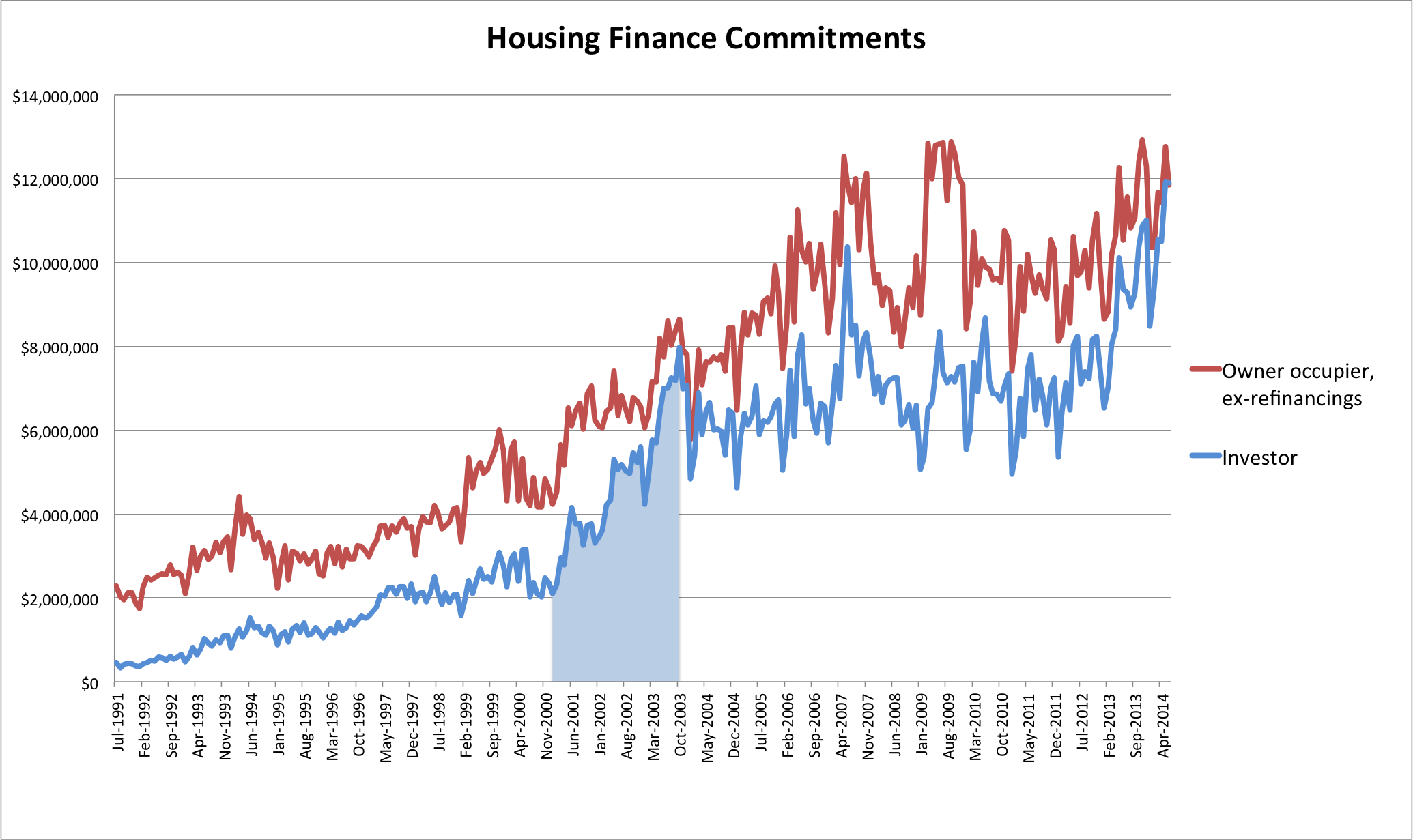
Although the growth in the proportion of all mortgages going to investors moderated between 1997 and 2003, this was largely a result of a similarly enthusiastic dash for credit by owner-occupiers, and in fact the level of total investor mortgage credit in the economy exploded in the new millennium. The approximate period of this investor frenzy is highlighted on the following charts. (All data sourced from the ABS).
hosuing finance commitments

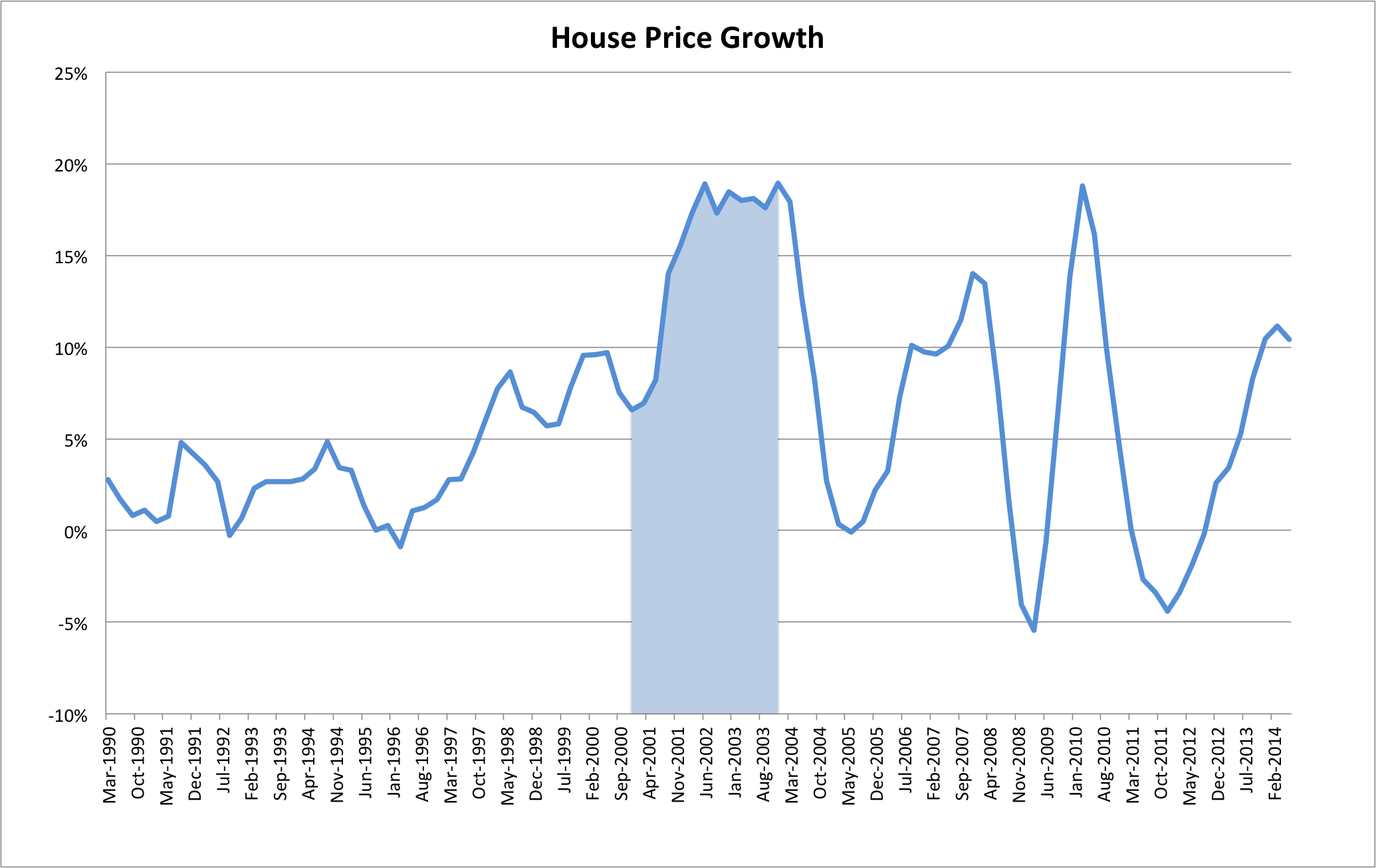
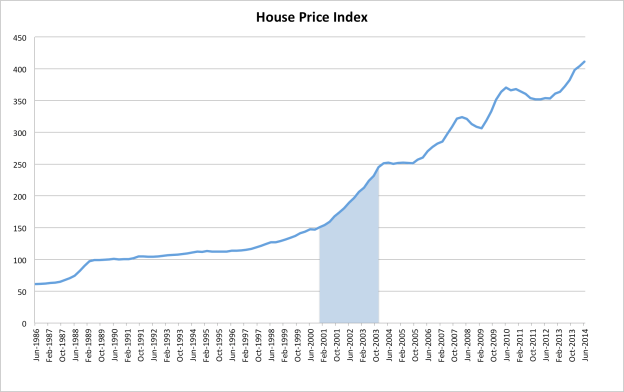
Consequently, growth in house prices greatly accelerated over this period. (The house price index chart combines two series which are not directly comparable, since there was a change in methodology after 2005. I’ve rebased the second series so that it matches up; it’s not precise but it’ll do for the purposes of illustration).
House price index

house price growth

As you can see, 2002 and 2003 saw especially rapid price appreciation, and slowed markedly thereafter.

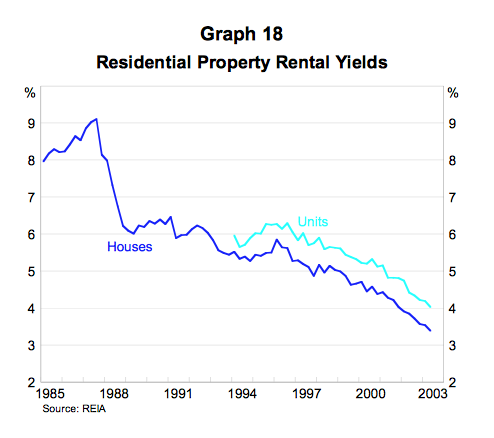
We’ve already seen that the boom pushed house prices to great heights relative to incomes. They were similarly expensive when valued by another key metric: rental yields.
Screen Shot 2014-09-10 at 12.43.42 pm

I don’t find it much of a stretch to label this episode a ‘bubble’, with the single but important qualification that it did not burst with any severity.

Bubbles have long been confounding phenomena for the economics community. Under once-fashionable assumptions, there can be no bubbles, for they defy human rationality. And yet we humans possess a stubborn contempt for our theorised behaviour, and bubbles are most assuredly real. But how to spot them? A popular view holds that a bubble can only be identified by an autopsy; until it bursts, we cannot definitively say that this or that asset market is a bubble.

I do not subscribe to this view. Rather, I agree with the argument it is possible to identify bubbles before they burst, with some degree of confidence, through key valuation metrics. The more pronounced the departure from fundamental value, the more likely a market is to be experiencing a bubble. Of course, there is always uncertainty. In particular, identifying the signs of bubble does not tell you when or how it will burst, nor does it preclude the possibility of external circumstances changing in ways that shift the dynamics of the market.

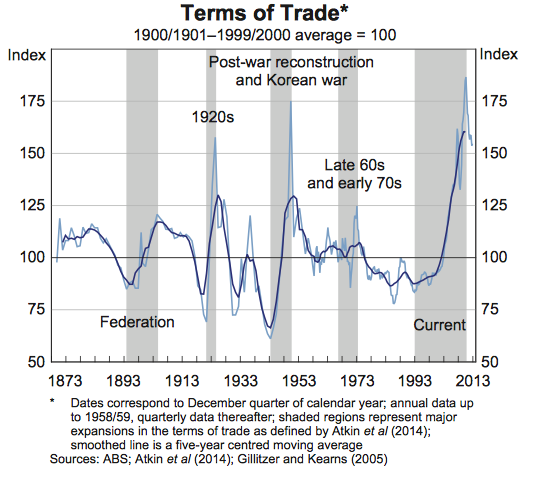
On this, Australia provides an exceptional case in point. Conditions in the housing sector leading up to 2003-2004 were undeniably bubbly, and without a sudden and spectacular rise in national income, would almost certainly have entailed a nasty hangover. Fortunately, a sudden and spectacular rise in national income is exactly what we got, courtesy of the biggest terms of trade boom in our nation’s history, which happened to arrive in earnest almost precisely as we passed peak of the housing boom. Again, the approximate period of the most manic half of the boom is shaded.
tot

This was extraordinary good fortune, even for the Lucky Country. Tax receipts pouring in from the corporate sector allowed the Howard government to reduce the tax impost on households. In addition, households came to regard savings as an unnecessary encumbrance, leading to a consumption boom. The surge in household income brought the value of house prices relative to incomes down to a more reasonable level. Anyone worrying about a housing bust following the boom was quickly disabused of the notion (the article links don’t seem to work on that page, but you get the picture).

This had important ramifications for Australia. It largely locked-in the price gains from the boom, further reinforcing the belief that house prices do not fall in a significant or sustained manner. In conjunction with the experience of the global financial crisis- when housing markets crashed around the world but Australia’s sailed through thanks to supportive government schemes, a second leg higher in the terms of trade, and a domestic investment boom- Australians now have a powerful historical precedent supporting the case for property investment (exemplified here by Adam Carr, with more than a trace of hubris).

Groundhog Boom

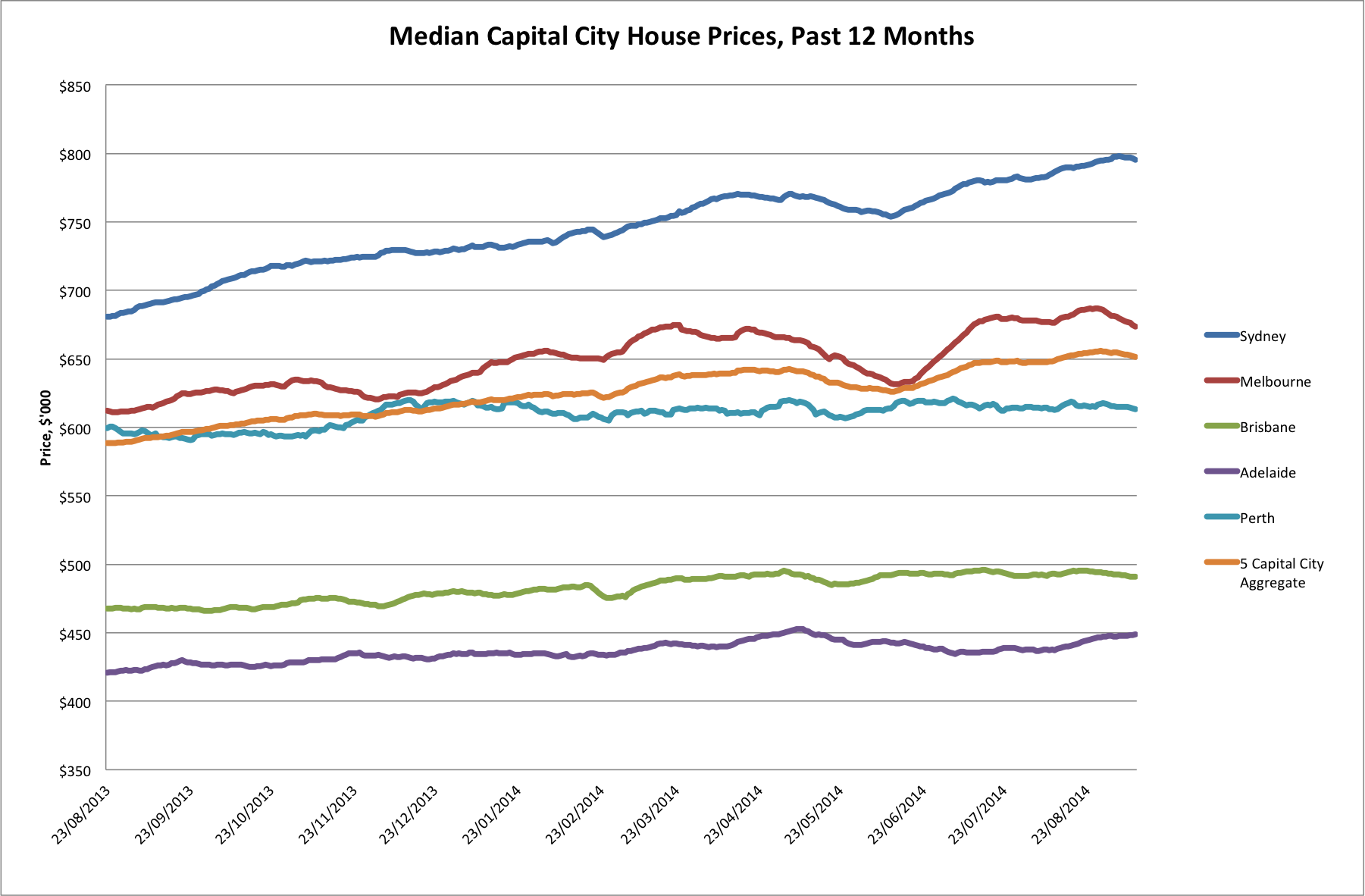
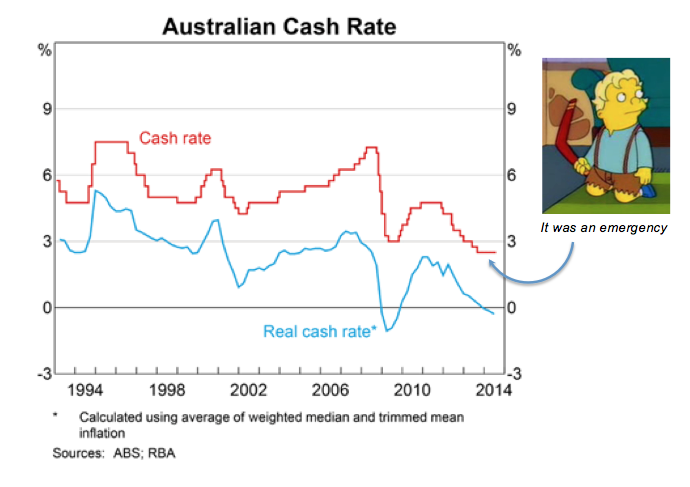
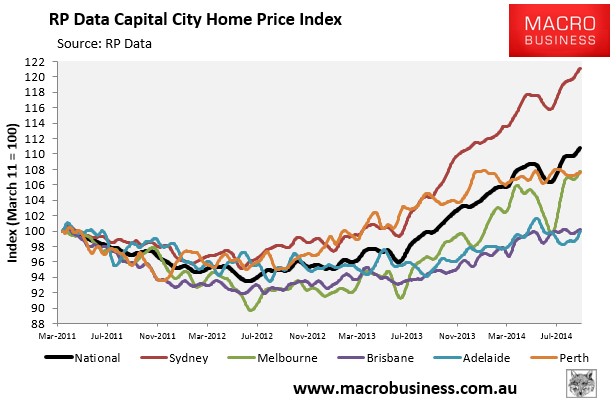
As is evident on the ‘housing finance commitments’ chart above, there has been a renewed surge in investor activity in the housing market in the last couple of years. The impetus for this was, as usual, a sharp decline in interest rates. As such, house prices have been buoyant, led by Sydney (as in the previous boom).
ScreenHunter_52-Aug.-28-16.00

Median House prices

We can clearly observe the 2014 winter lull on that chart from MacroBusiness, which some commentators conjectured to be the peak. Now that house prices have picked up the pace again, we await to see what the spring buying season brings. Are we nearing the peak, or will we scale new heights over the next 12 months? Will the laggards follow Sydney into the stratosphere, or will Sydney be left lonely on the mountaintop?

They’re pertinent questions (at least to this series of posts!). The housing boom, Sydney-centric though it may be, is really all that’s preventing the RBA from cutting further, since the only sectors of the economy responding with any verve to lower interest rates have so far been house prices and residential construction. Households remain reluctant to open the purse strings, despite the fabled ‘wealth effect’ of high asset prices, and the non-mining corporate sector is for the most part loath to invest, even with cheap credit, which is hardly surprising given the terribly elevated cost structure bequeathed to the economy by the terms of trade boom.

If house prices can find the legs for another big move higher, don’t expect the RBA to cut interest rates. As Glenn Stevens has articulated, there is concern within the bank about the state of housing. Conversely, if house prices steady and then start to cool, there is little else in the economy indicating a case for higher interest rates. Speculating on the precise path of house prices is more art than science, and depends on how long investors remain bullish on a market in which end-user demand is increasingly scarce.

One thing is abundantly clear, however; and that’s the radically different outlook for the terms of trade this time around. We are witnessing a robust, if localised, boom in the housing sector, with a high level of participation by buyers who are simply looking for capital appreciation. If a ‘once-in-a-century’ export boom rescued property the last time around we saw a speculative boom, then the question property bulls must answer today is, what will rescue it this time? (Admittedly, the boom was of a greater magnitude in 2003, though the current one started from a higher base.)

In stark contrast to the pinnacle of the last boom, national disposable income is now in decline and will continue to decline until either our terms of trade rebound or our real exchange rate falls far enough that improved competitiveness puts a floor under disposable incomes, at a much lower level. I outlined in the previous post why we’re unlikely to see China drive the terms of trade higher again. It’s not impossible in the short-run, but over the medium- to long-term, the glory days are well and truly past.

Recall that the overwhelming consensus in Australia is that the RBA will hike in its next cash rate move. The expectations underpinning this view are that the terms of trade will stabilise, with iron ore rebounding to roughly $100 a tonne in the near future, and that the interest rate-sensitive sectors of the economy go on expanding, until household consumption and rising asset prices start to tighten the labour market and pressure consumer prices, such that the RBA must lift interest rates.

This is not my view however, and I’ll wrap up this series in the next post with a summary of why that’s the case.

Part 5: The End of the Beginning

Straya T’day 8/9/2014

Chinese markets were closed today, so there was nothing concrete to spook or save the miners. A few iron ore plays caught a bid on the absence of bad news, with FMG up 2.3%. Generally not much movement and all we wait with bated breath for renewed signals. Plenty will be hoping a bottom is close for iron ore (aside from the shorts who’ve been piling in lately).

Roy Morgan released its Australian business confidence survey, which recorded a slight dip from last month. The survey has declined markedly from its post-election high last year, and is now below the average level of the past 4 years. Most worrying, overall sentiment is being underpinned by ebullience in the finance and real estate sectors, reflecting the strong housing market, while sectors such as retail, manufacturing and construction are all in the doldrums. Not a reassuring combination for anyone concerned with Australia’s post-mining boom structural adjustment. Tomorrow we’ll get the more closely-watched NAB business confidence survey, which has been showing decidedly more upbeat corporate sentiment of late (down only slightly from the post-election high).

Also released today was the ANZ job ads survey, which continues to show a modest improvement in labour market conditions, registering a 1.5% gain over the month. Chief Economist Warren Hogan noted that this appears at odds with the last employment data from the ABS, which recorded a sharp increase in the unemployment rate to 6.4% from 6% the month prior. The next employment report is out on Thursday and is expected to show an increase of 15k jobs and a drop in the unemployment rate to 6.3%. It’ll be very interesting to see how this release goes, given the signs of a gradual thawing in economic conditions, which must nevertheless be set against the looming menace of falling mining investment (to say nothing of the terms of trade beat-down).

The big story today however was Chinese trade data. The trade surplus came in at a record $49.8bn, and well above expectations for a $40bn surplus. Exports were up 9.4% for the year, following a 14.5% rise in July. Adding to the surplus was the decline in imports, which fell 2.4% after a 1.6% drop in July. While these figures are positive for China, a mrs pressing concern for this blog is the welfare of Australia; and despite appearances, what’s good for China is by no means good for Australia.

Buried within these data are some worrying portents for Australia. Coal imports slumped to 18.86m tonnes in August, the second month of decline and the lowest since September 2012. The promise of coal has long passed for Australia, but it remains noteworthy all the same that domestic prices in China are sitting at 6-year lows. More important than the drop in coal imports was that of iron ore, which fell 9% from the previous month.

The official party line throughout the ore rout this year has been that it’s a supply-side issue; soaring output is weighing on prices. The corollary being that while there may be lower prices these days, Australia has ramped up exports to compensate. This has it’s own set of problems for juniors, of course, whose business models don’t compute at lower prices, but for the most part it’s been an accurate appraisal of the market. However, as the esteemed David Llewellyn-Smith noted last week, “there are good reasons to be concerned that what started as a supply side issue for iron ore is very quickly swinging to a demand side problem for steel.”

Unfortunately, today’s trade data, in conjunction with recent steel output data showing a sharp drop off this month, suggest we are indeed beginning to see cracks in Chinese iron ore demand. No doubt there is a seasonal element to the fall in steel output and thus ore demand, but it has been an unusually large fall and, moreover, this simply reinforces the fact that without more fixed asset investment-driven stimulus, we just aren’t going to see a lift in steel demand, steel output, and iron ore demand that is anywhere near big enough to mop up the supply deluge.

Expect more iron ore price pain and a comparatively listless rebound when it comes.

The weak in iron

Gravity-doesnt-work-till-you-look-down-–-Roadrunner-Coyote

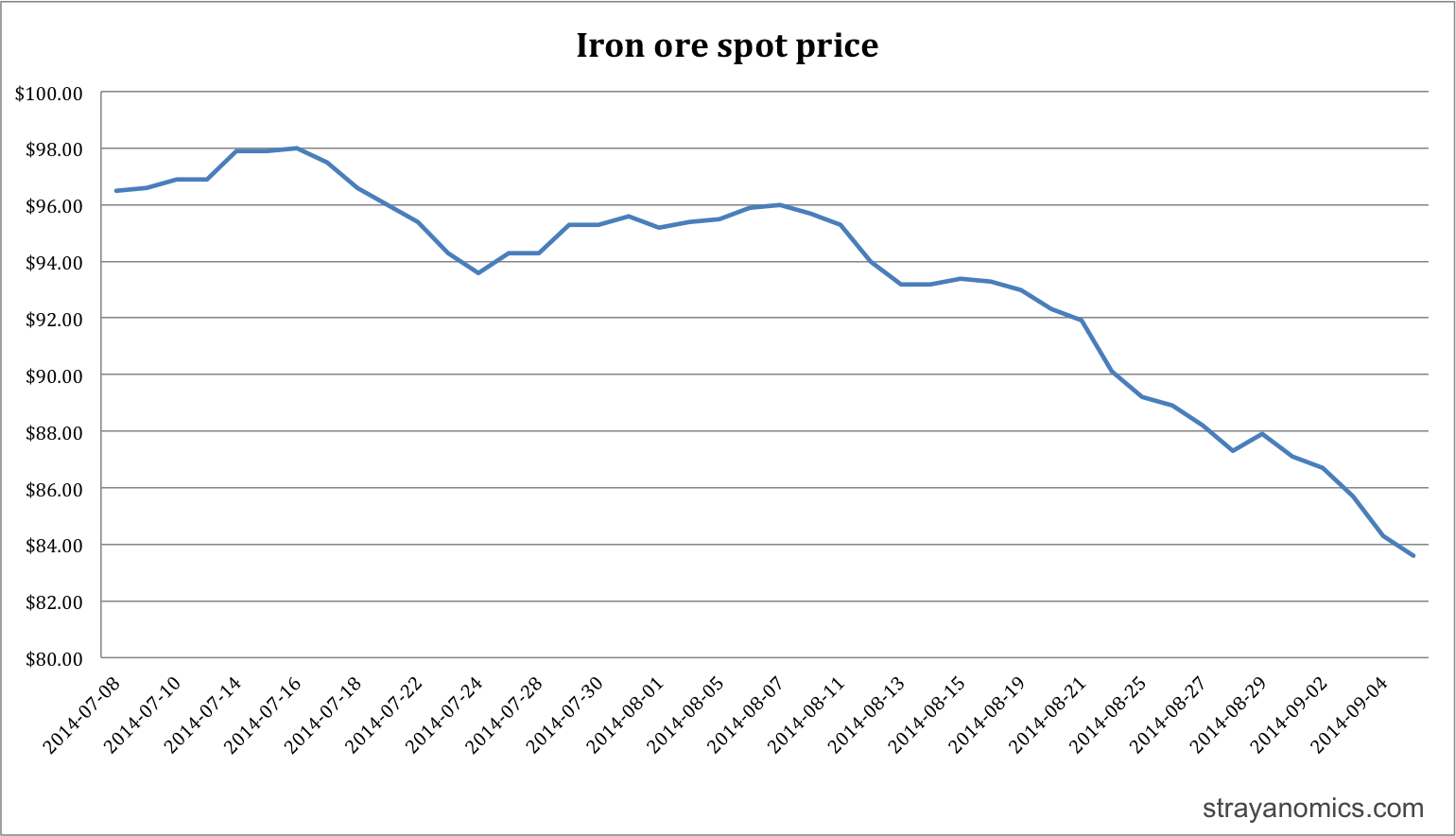
Another rough week for iron ore. Last week it breached the previous low for the year, this saw it take out the 2012 low of $86.70, and tumble straight down for a close of $83.60.

iron ore chart - Sept week1

It’s now fallen in 14 of the past 15 sessions. For the year it’s down 37.7% in USD-terms, and 40.7% in AUD, due to the ongoing resilience of the latter.

Sadly we can expect little respite from a falling AUD, thanks to the stubbornly lukewarm US labour market, the belated arrival of ECB easing, and a stampeding housing market preventing further rate cuts in Australia. There is much chatter these days about the starkly divergent paths of iron ore and the Aussie dollar. Intuitively this seems odd, after all iron ore is easily our largest single export, however it’s merely a loud reminder that the goods market holds little sway in the setting of nominal exchange rates; capital markets rule. As long as it’s relatively lucrative to borrow offshore and hold short-term AUD-denomiated assets, we aren’t likely to see a sustained fall in our currency.

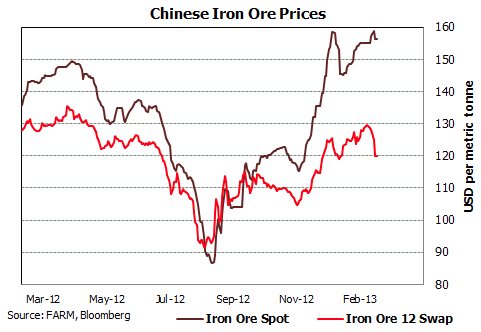
So we’re left to pour libations and pray for a swift rebound in spot prices. There is a strong precedent for this. At the moment the market is traveling in much the same way as it did during the 2012 destock rout, which was savage but short-lived.

Screen Shot 2014-09-06 at 5.30.50 pm

Are we likely to see a similar whipsaw this time around? I suspect not, for the following reasons.

  • India knocked some 100m tonnes out of the seaborne market in late 2012 with its epic regulatory own-goal. That’s not there to disappear now.
  • Stimulus via fixed asset investment flowed freely in 2012, and, critically, the property sector commenced a strong upswing around the time iron ore bottomed (see chart below). It is far less likely that the government will embark on a similar path this time, for reasons sketched out here. Targeted fiscal support is likely, but a rebooting of the heady investment boom is not. If this plays out, steel demand will be flat or falling, with deleterious consequences for the suppliers of the iron ore deluge.
  • There is now an iron ore deluge.

CHina property prices

Inventories held by steel mills are low-ish at the moment, while stocks held at port most certainly are not. This appears to be a fundamental shift in the market, making an aggressive restock a la Q4 2012 less likely. We’ll see the price bottom out and rebound eventually, of course, but without a hasty U-turn in Chinese government policy (something that needs to be monitored closely), this decline in iron ore is structural. As I said last week; lower lows and lower highs until sufficient supply capacity drops out of the market to stabilize prices. If demand for iron ore, which has so far remained robust, starts to turn, heaven help us.

Strayan Rates – Part 3: China

This is the third instalment in a series on the outlook for Aussie interest rates. Part 1 identified the opposing forces competing for primacy at present: a terms of trade shock due to shifting growth patterns in China and a housing boom that risks destabilising the economy down the track. Hiking interest rates aggressively would hit the housing market on the head. Yet the external shock unfolding, combined with the impending decline in mining investment activity, means that lifting interest rates would be ruinous for the economy, akin to flooding the valley to extinguish a house fire (or bull market, as it were). Unsurprisingly, the RBA has been averse to such a move.

As even the most insular Australians are surely aware, China plays an outsize role in our economic fortunes. Examining how and why this came to pass is vital for understanding the future direction and composition of the Chinese economy, and what this means for Australia.

Breathing Fire

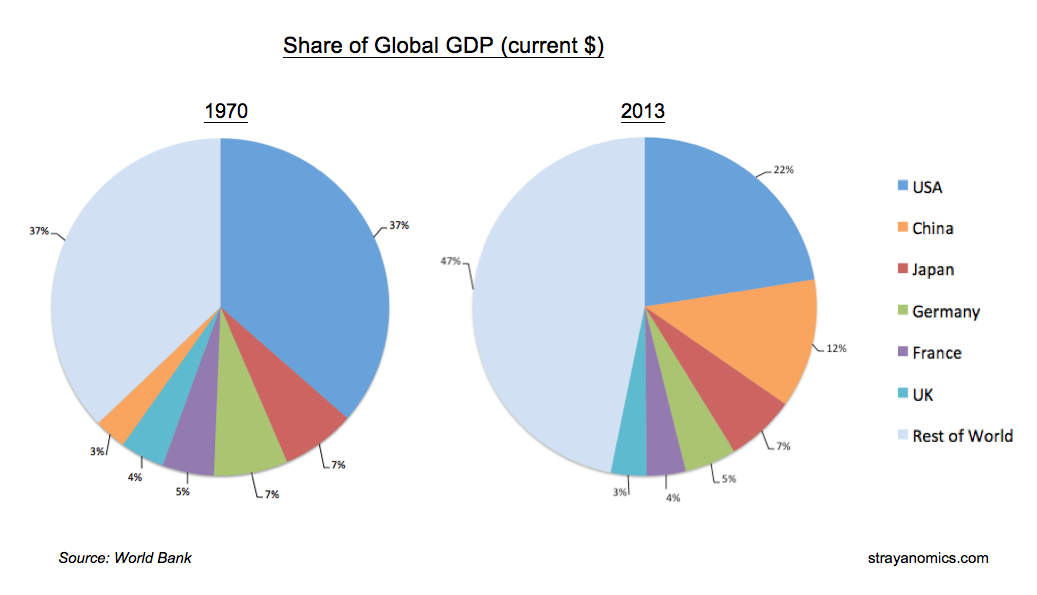
China initiated limited economic reforms in the late 1970s, and since then growth in output has averaged close to 10% a year. There are few historical precedents for such a sustained period of rapid growth; certainly the sheer size of China, with 20% of the world’s inhabitants, means that the global impact of China’s rise has been without equal. The following chart illustrates this shift in relative economic clout. Screen Shot 2014-09-01 at 9.56.25 am

For those who prefer a longer timeline, there’s this from Angus Maddison (by way of The Economist), which shows China’s long march back to global preponderance.

Screen Shot 2014-09-01 at 12.54.54 pm

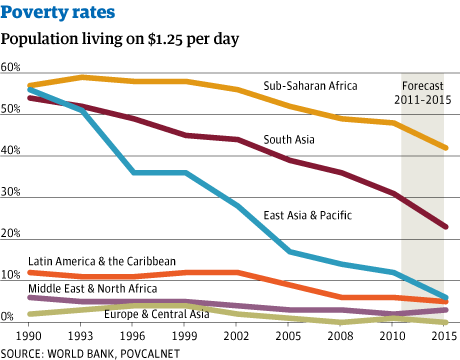
The domestic impact in China has been just as momentous, with around 500 million Chinese lifted out of severe poverty since the reform process began. This achievement is simply without parallel in world history.

Poverty_rates1-001
Chart from The Guardian

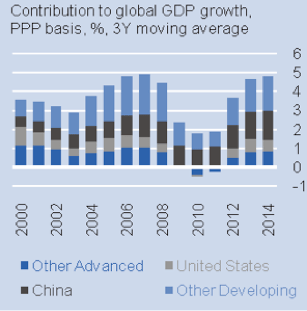
China’s growth was quick but erratic during the first couple of decades of liberalisation. However, since the Asian Financial Crisis (1997-1998) China has grown with remarkable consistency. This period of stable growth, in combination with abundant global liquidity, had a huge impact on the economic performances of developing nations. Ruchir Sharma notes in Breakout Nations, “Between 2003 and 2007, the average GDP growth rate in these (developing) countries almost doubled, from 3.6% in the two prior decades to 7.2%, and almost no developing nation was left behind.” China’s voracious demand for imports of raw materials was an important part of this phenomenon. Since the financial crisis in 2008, and the resulting slowdown in the developed economies of Europe and the US, China has easily been the largest single contributor to global GDP growth.

Screen Shot 2014-09-01 at 4.12.55 pm
Chart from Vox

Patterns of Growth

From the seizure of power by the Communist Party (CCP) in 1949 through to beginning of the ‘reform era’ in 1978, China was primarily reliant on the centrally-planned accumulation of physical capital in its attempts to industrialise. Its capital/output ratio was high during this period, and productivity was low, reflecting the inefficiencies of this system (more investment in productive capacity than actual production). International trade was almost non-existent. Partly due to these failed economic policies, China was desperately poor. In the late 1970s its per capita GDP was less than two-thirds of the African average (see Maddison, 2003).

After Mao Zedong died in 1976, power within the CCP shifted to reformers, with Deng Xiaoping chief among them. The reform process officially commenced in December 1978, when the CCP enshrined a new guiding principle of economic development in place of class struggle. Deng had captured the rationale for this new pragmatic shade of socialism many years prior, with the marvellous aphorism, “It doesn’t matter whether it’s a white cat or a black, I think; a cat that catches mice is a good cat.” In other words; outcomes matter, not ideology. The general policy stance was known as ‘Reform and Opening Up’. Owing to persistent food shortages, the agricultural sector was the first beneficiary of the new leadership’s reformist approach. Price controls were relaxed, and farmers were granted the right to keep profits earned from any produce sold in excess of certain quotas. By 1984, when these reforms were completed, agricultural output had soared by 47% (see Zhu 2012 for this an many other useful figures).

Buoyed by successes in the agricultural sector, the government expanded market reforms to other industries. Private enterprises quickly ballooned, with employment in these organizations rising from 15% of total employment in 1978 to 39% by 1988. This was the first phase of China’s development; institutional reform led to markets emerging as price-setting and resource-allocating mechanisms, and private enterprise flourished.

The process continued through the 1990s; state-owned enterprises were privatised (or their management given more independence), and international trade and investment expanded. In particular, export-focused manufacturing boomed. However, this newfound commercial vibrancy, along with the demands of a growing urban population, required substantial infrastructure upgrades: roads, ports, railways, utilities, housing, schools, hospitals, and so forth. It turned out China was well-suited to the task of ramming through major infrastructure projects, having retained an authoritarian political character despite the government’s liberalising economic reforms. However, this state-sector involvement in the economy inevitably offered opportunities for privileged insiders to exploit political connections for personal gain; ‘rent-seeking’, in economic parlance.

China’s enthusiasm for reform stalled and the role of state-led investment became more entrenched with the eruption of the Asian Financial Crisis in 1997-98. To evade the fallout from the crisis, the government supported overall demand by boosting investment spending. Any inefficiencies that may have been creeping into the system as a result of this increasing prominence of the state were buried beneath the surge in trade and foreign investment which followed China’s accession to the World Trade Organization in 2001.

Unfortunately, this export-dependent model suffered a blow with the arrival of the next international financial crisis in 2008. Demand dived in the enfeebled, debt-drenched economies of the North Atlantic, and China’s exports cratered.

Screen Shot 2014-09-02 at 1.40.33 pm
Chart from FTAlphaville

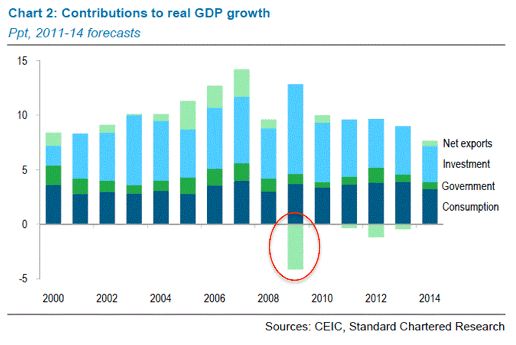
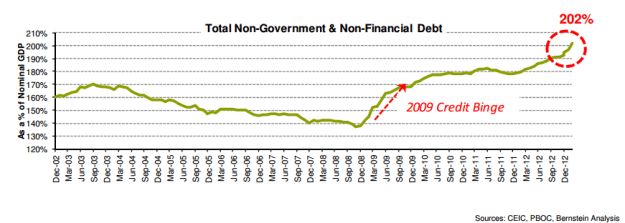
The response from China’s government to this decline in foreign demand was swift and emphatic: it doubled-down on state-directed investment and unleashed a tidal wave of credit upon the economy, effectively substituting domestic investment spending for the loss in foreign demand for Chinese exports. This is evident in the massive increase in investment’s contribution to GDP growth in 2009 (see above chart), as well as in aggregate credit figures:

China-total-nongov-nonfin-outstanding-debt-as-percentage-of-nominal-GDP-Werner-Bernstein
Chart from FTAlphaville

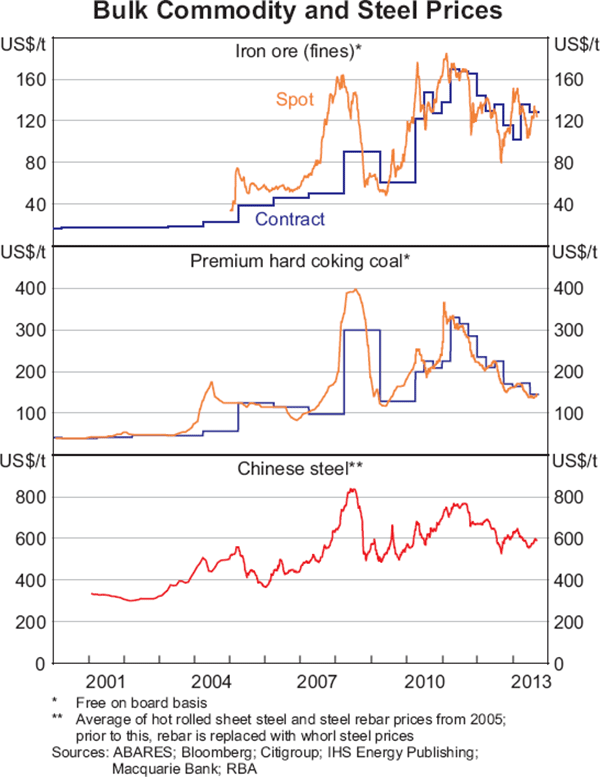
This new credit funded infrastructure projects and ignited a boom in property, with land and dwelling prices and new construction all surging. The consequent stats are ready-made to awe: China produces roughly as much steel as the rest of the combined, accounts for 40% of global copper demand, two-thirds of global seaborne iron ore demand, and apparently produced as much cement in 2011 and 2012 as the US did over the entire course of the 20th Century. Naturally, this surge in construction activity dramatically boosted demand for raw materials, which proved an enormous (albeit temporary) windfall for commodity exporters like Australia. The slump and quick rebound courtesy of Chinese stimulus are apparent in spot prices for iron ore and coal.

graph-0913-2-01
Chart from RBA

The peak for iron ore and coal prices in 2011 also happened to be more or less the zenith for the current incarnation of China’s seemingly miraculous growth model; one exemplified by the ascendancy of commodity-intesive investment spending. Since then, the government has been at least nominally committed to a renewed reform effort to rebalance Chinese growth away from an over-reliance on investment and towards consumption demand. However, there were scant signs of genuine policy adjustments until late 2013.

China Today

Early on in China’s development story, rising investment was a sensible and necessary accompaniment to an expansion in private sector productivity resulting from liberalising reforms. Yet public sector investment over the past decade and a half has increasingly become the primary source of growth, rather than an augmentation of other productive activities. The core argument is simple: if China does not find sources of consumption demand, it will be saddled with endemic overcapacity in a number of industries and face the hangover from years of uneconomical investment. This paper from the IMF goes into detail.

The extent of China’s ‘over-investment’ issues remains a matter of debate. For instance, concerns about the economic justifications of the massive high-speed rail network China has constructed in the past few years look to have been overblown. Much of the infrastructure that has been built is no doubt useful and economical. Nevertheless, there are clearly areas of substantial overcapacity in the Chinese economy; for example in steel, cement and coal production, a well as the property market, and this matters greatly for Australia. A successful rebalancing of the Chinese economy almost certainly entails considerably less demand for Australia’s key commodity exports, so any sign that the government is committed to such a path is worthy of our attention.

At the Third Plenum meeting last November, just shy of 35 years after a similar conclave agreed upon the groundbreaking reforms that ushered in China’s re-emergence, the CCP produced the most ambitious reform framework in years. Many of the new measures are specifically aimed at shifting wealth away of the state and state-affliated entities, towards the household sector and service industries, and in so doing helping to rebalance the economy after years of excessive investment spending. Some of the most important of these cover land reform, changes to the system of household registration (known as hukou), a new focus on the environment, and a deepening of market forces across the economy. After at least 15 years of ever-greater reliance on commodity-intensive investment spending, the intention is palpable amongst China’s leaders to assert a greater role for household consumption and private enterprise.

Implications for Straya

The immediate outlook for Australian interest rates hinges largely on the resolve of the leadership in China to continue along the path of renewed economic reform. To my mind, the short-term barometer of this resolve is the provision of credit. Credit is tight at present, and the property market is suffering accordingly. The government squeezed through a ‘mini-stimulus’ earlier this year, however the effects of this are already fading, and there appears to be very little appetite for a repeat of ‘big bang’ stimulus measures.

That being said, if deteriorating economic conditions see the Chinese government succumb to temptation, revive easy credit and fall back on fixed asset investment, then it is quite possible for iron ore to stage a strong rebound into the Q4 restocking period. In this scenario, the RBA could well fix its gaze firmly on the housing market, decide that the exuberance needs restraining, and hike interest rates next. This is the consensus view from all the surveys of market economists I have seen. If the terms of trade stabilise, then in the short-term low interest rates may well prove sufficiently stimulatory to warrant a hike.

If, instead, the Chinese government refrains from rescuing the property market with easy money, and stands firm in its commitment to the latest round of market reforms, we are likely to see Australia’s terms of trade continue to decline sharply (notwithstanding a light rally in iron ore later in the year). The direct impact of this hastening decline on the average Australian household is not especially great, though WA will feel the full brunt of it. However, it will undoubtedly damage commonwealth revenues. That means a deteriorating federal budget and the likelihood of more scary noises about austere savings measures, which, as we saw earlier this year, households do not like. I find it highly unlikely that the RBA will hike rates in the midst of a terms of trade rout such as we are witnessing today. This will leave the cash rate on hold through until next year when the impact of lower mining investment, and the accompanying job losses, begin to appear more acutely.

If the Chinese government holds the line on reform and sanity prevails on credit growth, then the Australian housing sector, which I will examine in the next post, will need to muster an almighty charge to overwhelm the effects of the terms of trade bust and declining business investment in 2015, and thus compel the RBA to hike. Not impossible, but an increasingly shaky proposition as the economy weakens.

Part 4: Safe as a House

Construction continues to soften

Data for construction work done was released by the ABS this morning, and continues to provide a neat snapshot of a bifurcated economy. 

Total value of construction work done for the June quarter came in at approximately $52bn, down 1.2% on the previous quarter. Expectations were for a 0.5% decline. 

Building rose by 1.5% in seasonally adjusted terms, led again by residential construction. However, this was more than offset by a 3.1% fall in engineering work done (mostly resource sector investment). 

Policymakers’ game plan for tackling the slowdown in resource sector investment activity has been to boost construction in the property sector, especially residential. The uptrend in building activity over the past two years is welcome, and suggests a measure of success for this strategy, even if it’s taken 225bps of RBA slashing to get it moving.

However, it’s also plain enough that home-building is not going to be able to completely fill the open-cut pit left behind by waning mining investment. In addition, current elevated levels of residential construction are being underpinned by high immigration, foreign demand for Australian property assets, and an unusually high rate of participation by domestic investors in the property market. These are not especially healthy characteristics and the risks are growing of a downturn in the property sector occurring at the most inopportune of times for the Australian economy. 

All-important private capital expenditure data out tomorrow, which will shed greater light on activity in the resources space. 

Strayanomics. Get around it.

I arrive a tardy guest at the econ blogosoirée. Not the most erudite of attendees, or the best-dressed, but an eager one nonetheless.

Australia is where I live. Among other things, it’s an economy. The economic forces that churn behind the scenes in the daily lives of Australians are of great interest to me. Of course, these forces are not confined to our shores; they bubble and rage from across the seas, enriching or imperilling us at their leisure.

They will also form the principal subject of this blog, as they do for a pantheon of other excellent blogs today.

Economic exchange is a fundamental activity of human civilization. When folks exchange things, a market arises. The craziest of all markets are financial. As peaceful as it would be to partition financial markets from the rest of our lives, they are deeply intertwined.

And so the vicissitudes of global financial markets will feature regularly, as again, they usually do on these sorts of sites.

I’ve adopted yet another mangled compound of the word economics as the title of this blog. Soz.

Australia. Economics.

Strayanomics.