Category Archives: Uncategorized

Straya T’day 14/10/2014

zombie hand

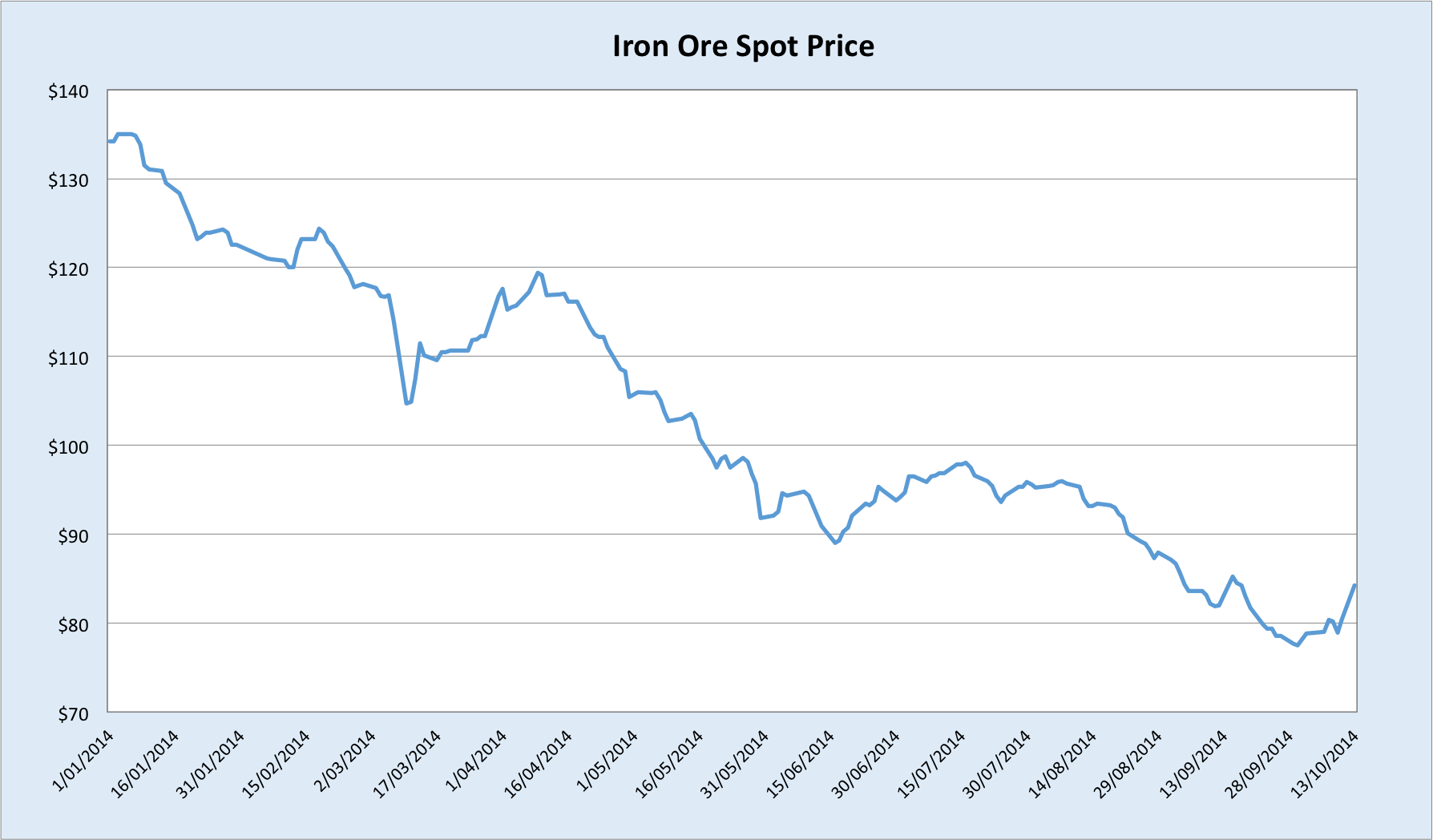
Iron ore is back!

I noted in a post on Friday that signs were suggesting the worst may have past for the iron ore miners this year.

Well, spot really turned it on yesterday with the biggest one-day gain of the year.

IO-2014

Here’s the latest from Reuters. There was undoubtedly a little short-covering happening in yesterday’s move. Dalian futures rose again today but the most-traded (Jan) rebar contract was flat.

The larger debate now is whether this move heralds a pronounced rebound as in 2012, when prices almost doubled between early September and late December. I have previously detailed why I think the restocking rally will not be anywhere near as aggressive this year, and that this view can only be undermined by a ‘big bang’ stimulus in China.

The recent bullishness has been stoked by an apparent loosening of credit conditions in China. This should support mortgage lending and support property prices, however I remain highly sceptical that the government will allow credit to flow freely enough that it reboots the boom. I therefore see current measures as aimed towards arresting the slide in property, which has been turning increasingly nasty of late, rather than reigniting the excesses of previous years.

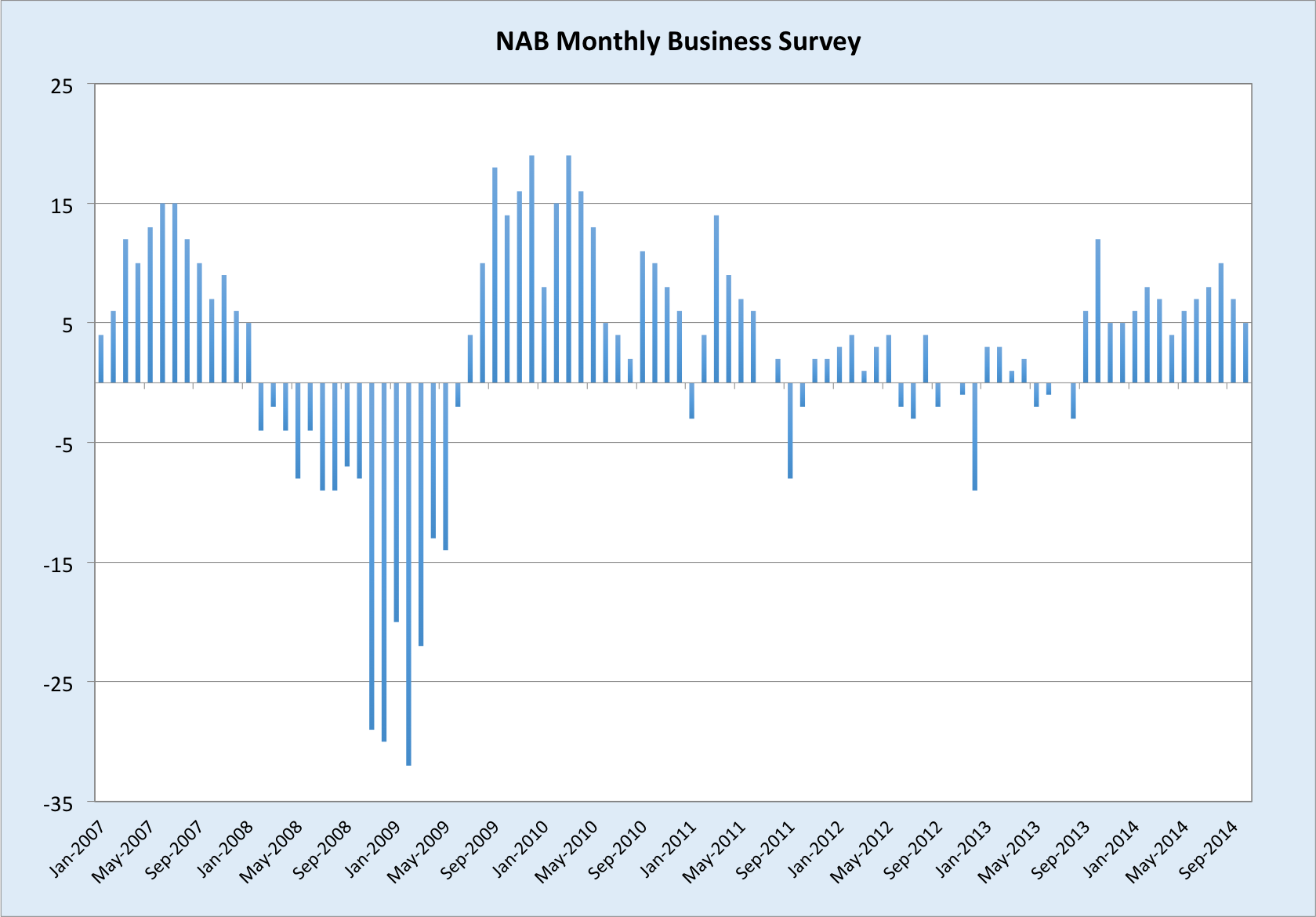
NAB business confidence slips again

Full Report

NAB

Straya T’day 10/10/2014

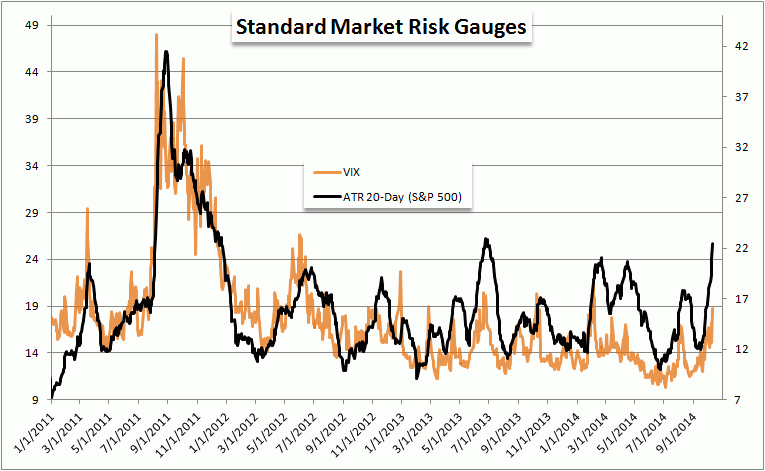
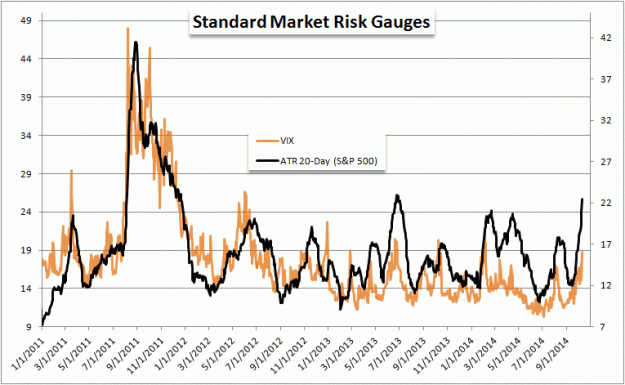
Arise, Sir Vol!

original_27786903
Chart from John Kicklighter

We’ve finally been treated to some decent volatility in the past couple of months. Although it was initially concentrated in foreign exchange markets as the USD rediscovered its mojo, we’re now seeing sizeable moves across the asset spectrum.

We’ll start with FX.

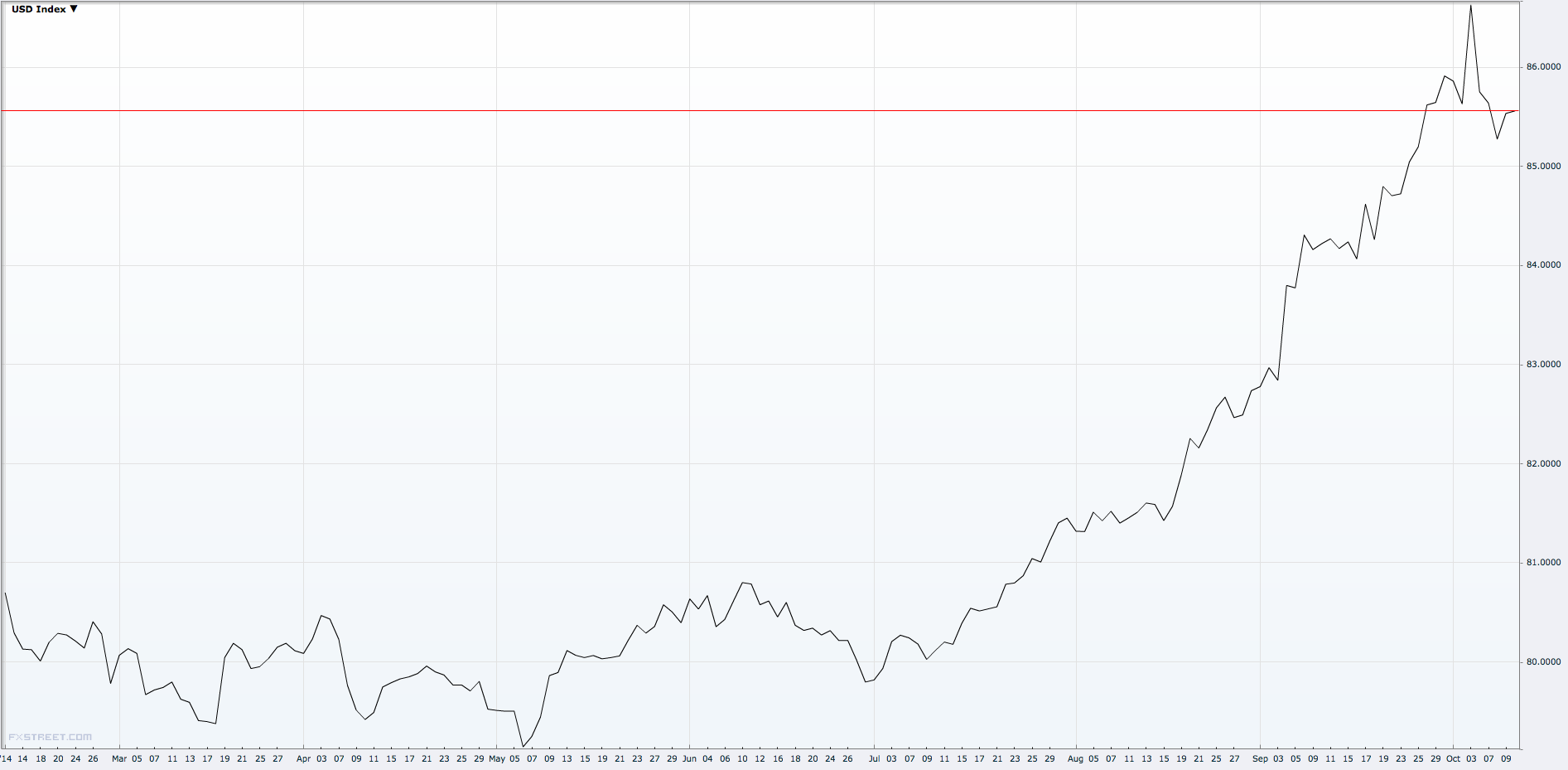
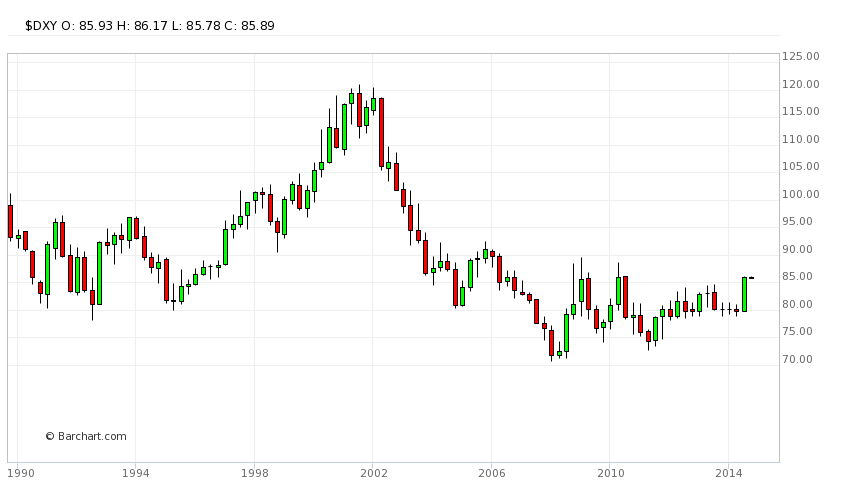
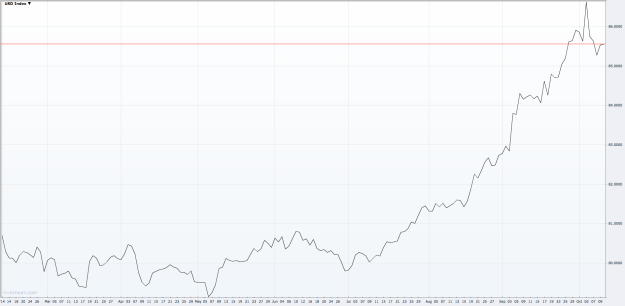
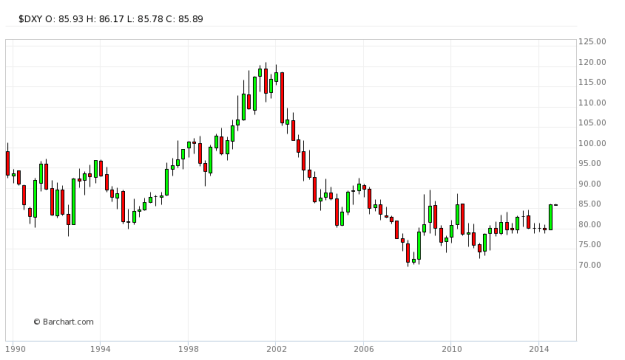
It’s no secret that the USD has been on a rampage these last couple of months (I’m preparing a post on the history of the USD post-Bretton Woods in which I’ll try to contextualise the current outlook for the dollar and its ramifications).
Screen Shot 2014-10-10 at 5.18.45 pm

Here’s how it’s looking on a long-term basis:
chartpng copy

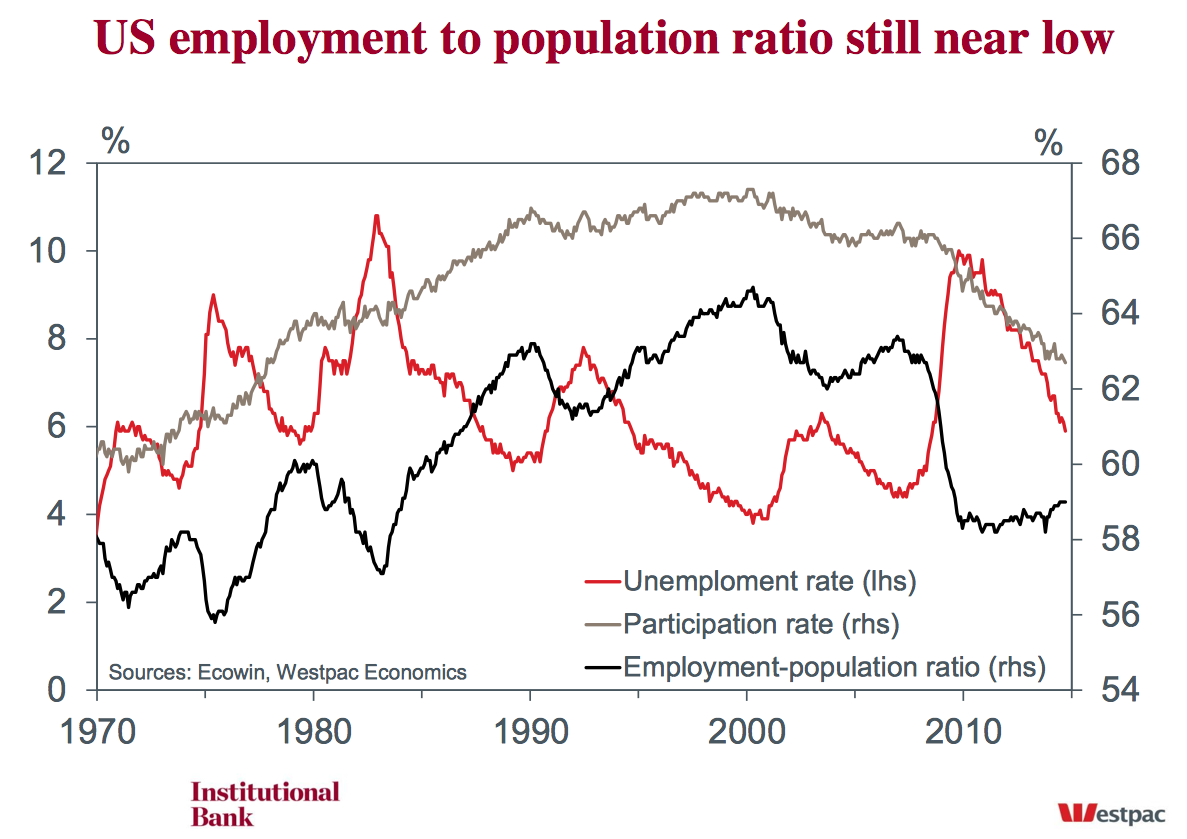
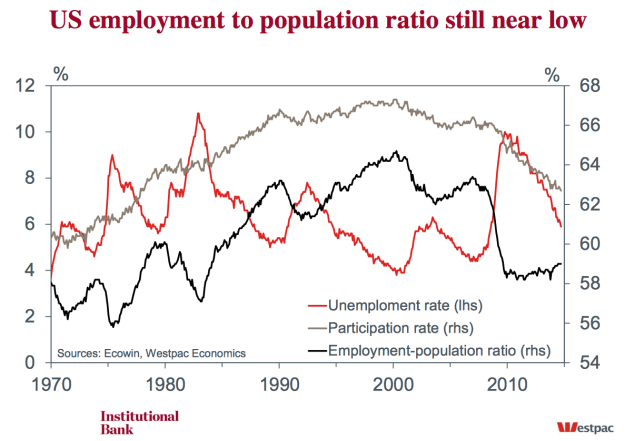
The proximate cause behind the timing of the rally was somewhat unclear, but the overarching case for a stronger USD has been sound for some time. The US is in the midst of the longest period of uninterrupted jobs growth in its history, at 55 weeks and counting, and the unemployment rate is down to 5.9% (here’s the latest jobs report). However, countering this is the fact that the decline in the unemployment rate has been largely accounted for by the decline in the participation rate, suggesting considerable slack remains in the labour market.
Screen Shot 2014-10-10 at 5.46.01 pm

Some of this is certainly a consequence of retiring baby-boomers, although the timing and pace of the fall, coinciding as it did with the onset of recession, makes me a bit suspicious of this as the dominant explanation. Nevertheless, the market excitedly seized on a paper from the Fed last month arguing that the fall in labour force participation was largely structural; the implication being that labour markets would tighten without a big rise in the employment-to-population ratio, and the Fed would be compelled to adjust monetary policy accordingly.

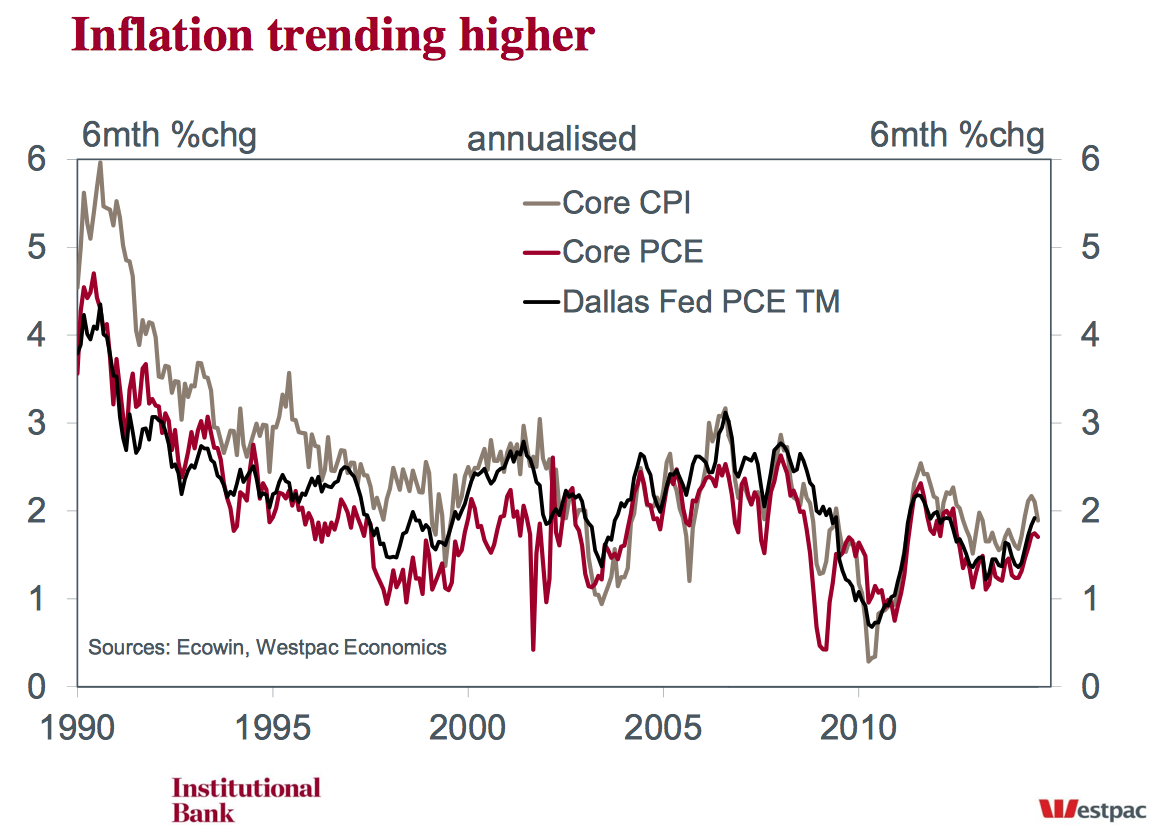
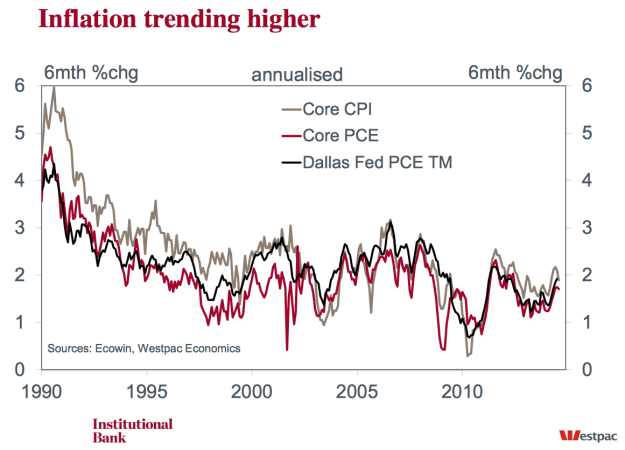
If this is the case, it’s not yet showing up in wage pressures. Inflation measures have been creeping up lately, but not in any concerning fashion. In any case, the strong dollar will knock these pressures on the head, should it continue to run as I expect it to.
Screen Shot 2014-10-10 at 6.04.28 pm

So although the US is improving, it’s hardly charging. The case for a stronger dollar has therefore centred on the miserable state of its peers. Germany is sinking into recession, adding to the persistent weakness plaguing the Eurozone, Japan is looking sickly after hiking the sales tax earlier this year, and China is doing its best to rebalance without detonating its debt time-bomb. Combined with the end of QE this month, the USD is looking the least ugly out of a pretty ordinary bunch.

Black gold

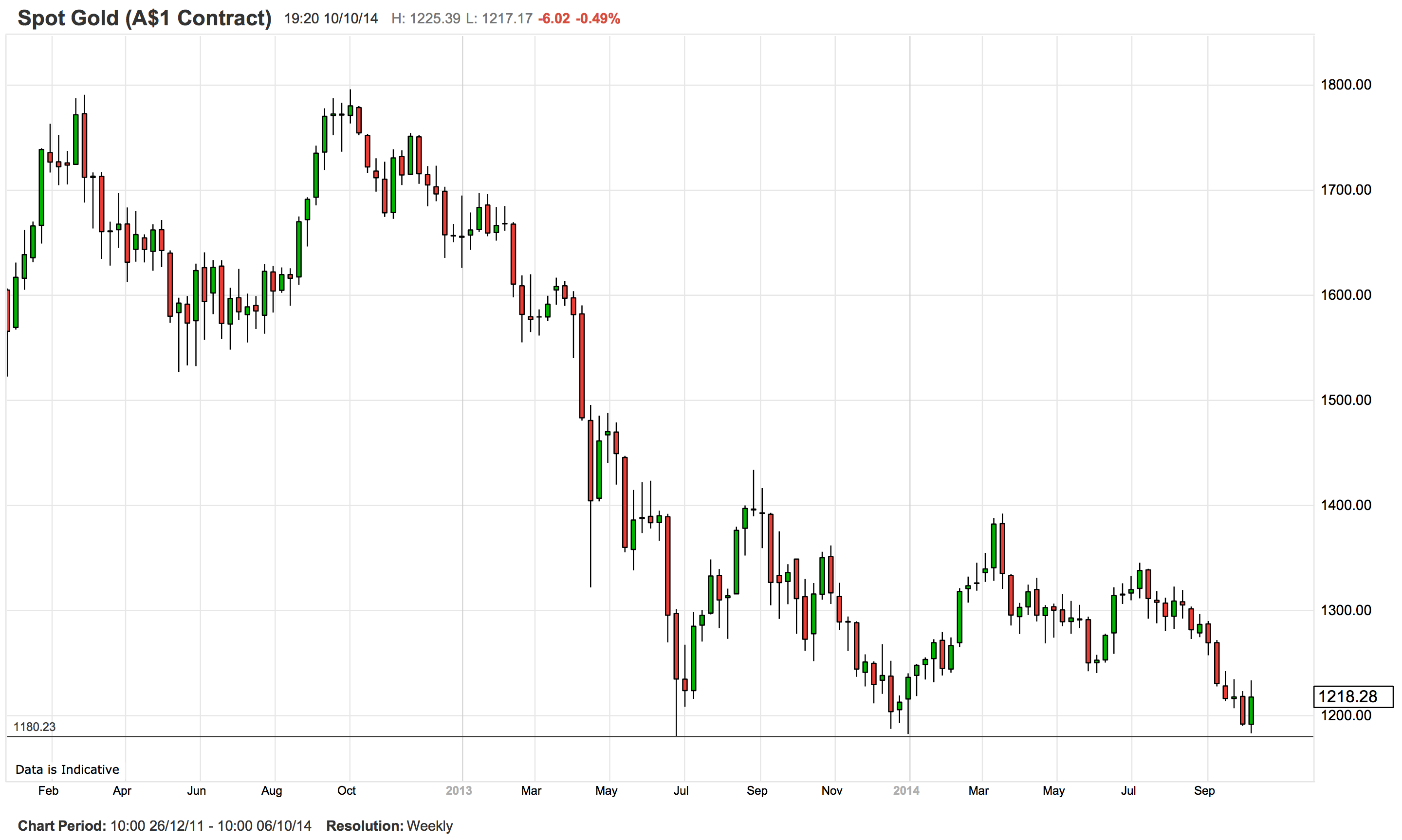
Many commodities have struggled under the weight of a resurgent USD, chief among them being the anti-dollar: gold.
gold1

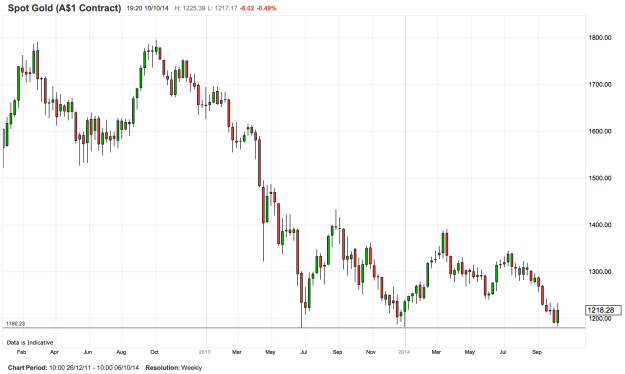
Gold managed to bounce off its double bottom at $1180, forming a triple bottom now. This is garden variety technical pattern which often would be interpreted as a bullish signal, but that’s certainly not how I’m looking at this market.

As you can see on the short-term USD index chart, the greenback gave up some of its gains this week as the Fed minutes showed some members were concerned about the negative impacts of weak external demand and the high dollar on the US economy. In truth the dollar really just needed a bit of breather after the run it’d had. This consolidation gave gold another kick up. It may be that gold finds a little further to rally, especially if equities continue to sell off, but in time expect critical support at $1180 to give way and gold to go much lower.

The entire ‘buy gold because the Fed is printing money, stoking inflation and trashing the dollar’ theme has been unraveling since early last year, as it became clear that QE would end with no inflation in sight and the dollar outperforming, rather than collapsing. Depending on the severity of the equities downturn and the followthrough on the dollar, I’d be looking for gold to break $1180 by the end of the year, heading below $1000 in fairly short order.

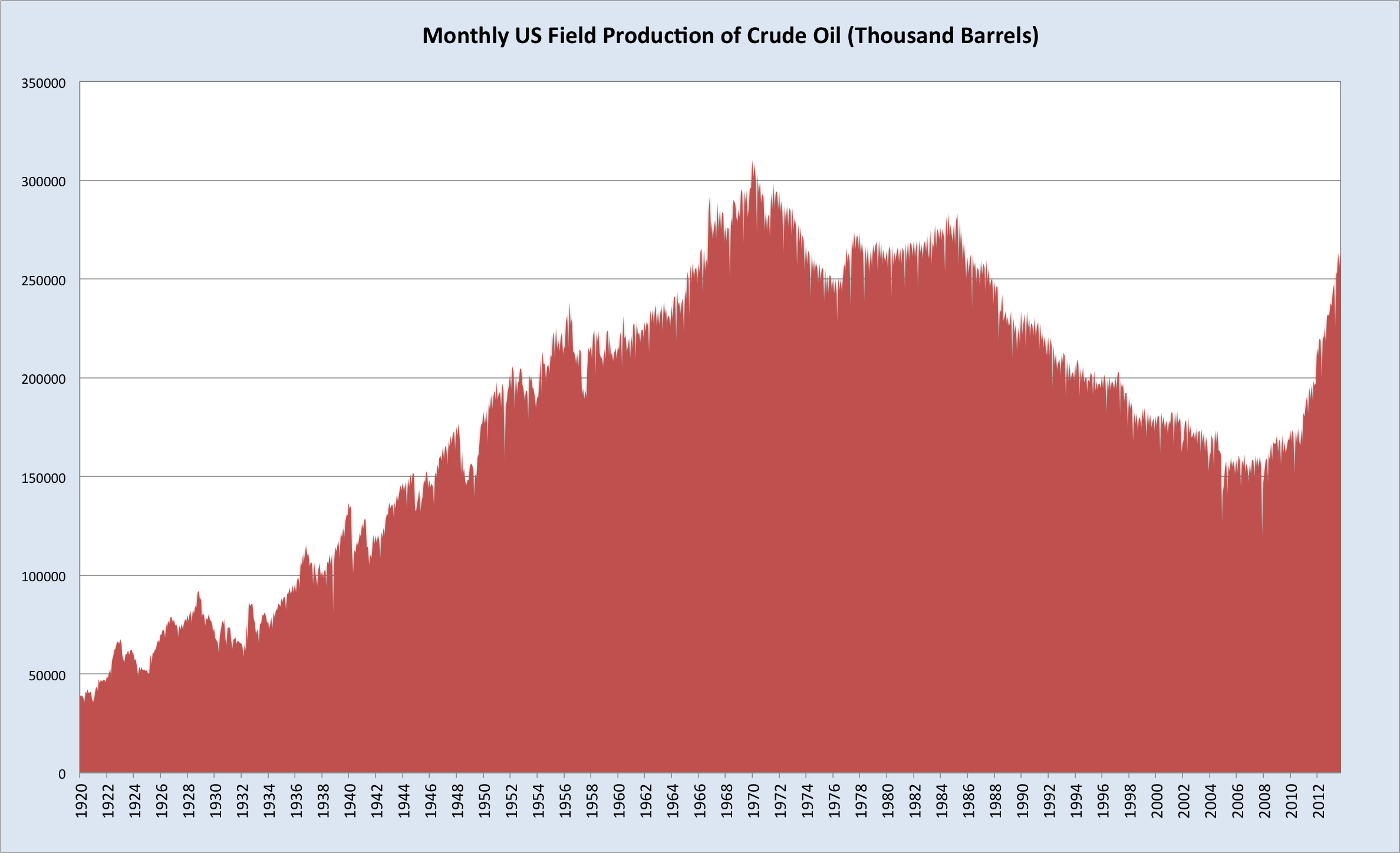
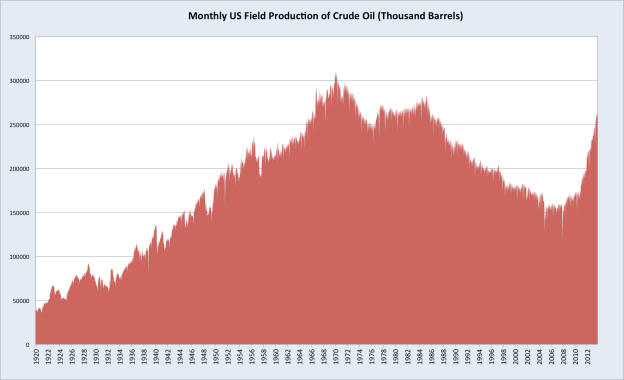
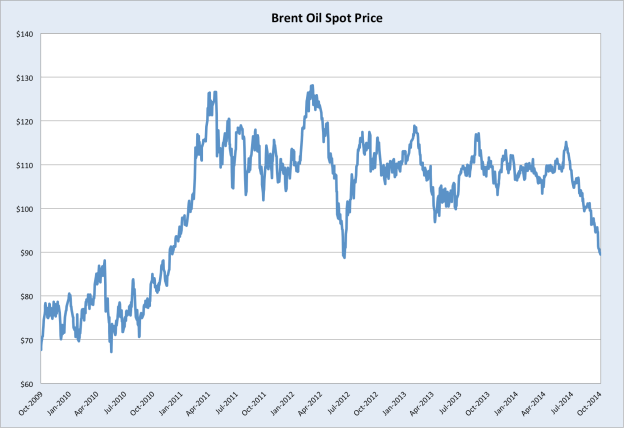
Oil has also been suffering under the weight of the strong dollar, although more importantly its fundamentals have been growing increasingly bearish. The US is awash with oil in a way it hasn’t been for decades.
US oil

This is the result of the shale and tight oil boom, which allowed previously inaccessible gas and then oil resources to be exploited. There are plenty of reasons to believe that this will be a relatively short lived spike in US production, but for now all you can do is recline and admire America’s capacity to revitalise itself at the most critical of moments.

Adding to the supply mix has been the return of Libyan crude to world markets, the stability of Iraqi output despite its dire geopolitical environment, and the disinclination among OPEC producers to cut output, as many assumed they would. This could well be a reflection of political tensions in the Middle East. The Gulf Arab states are embroiled in a vicious proxy war at present against the Shi’ite bloc led by Iran. Iran is seriously suffering with oil at current prices, giving the Arab states an incentive to maintain supplies and turn the screws on Iran. That’s just speculation of course; we’ll need to wait until the November meeting for a better gauge on OPEC’s response to the price slide.

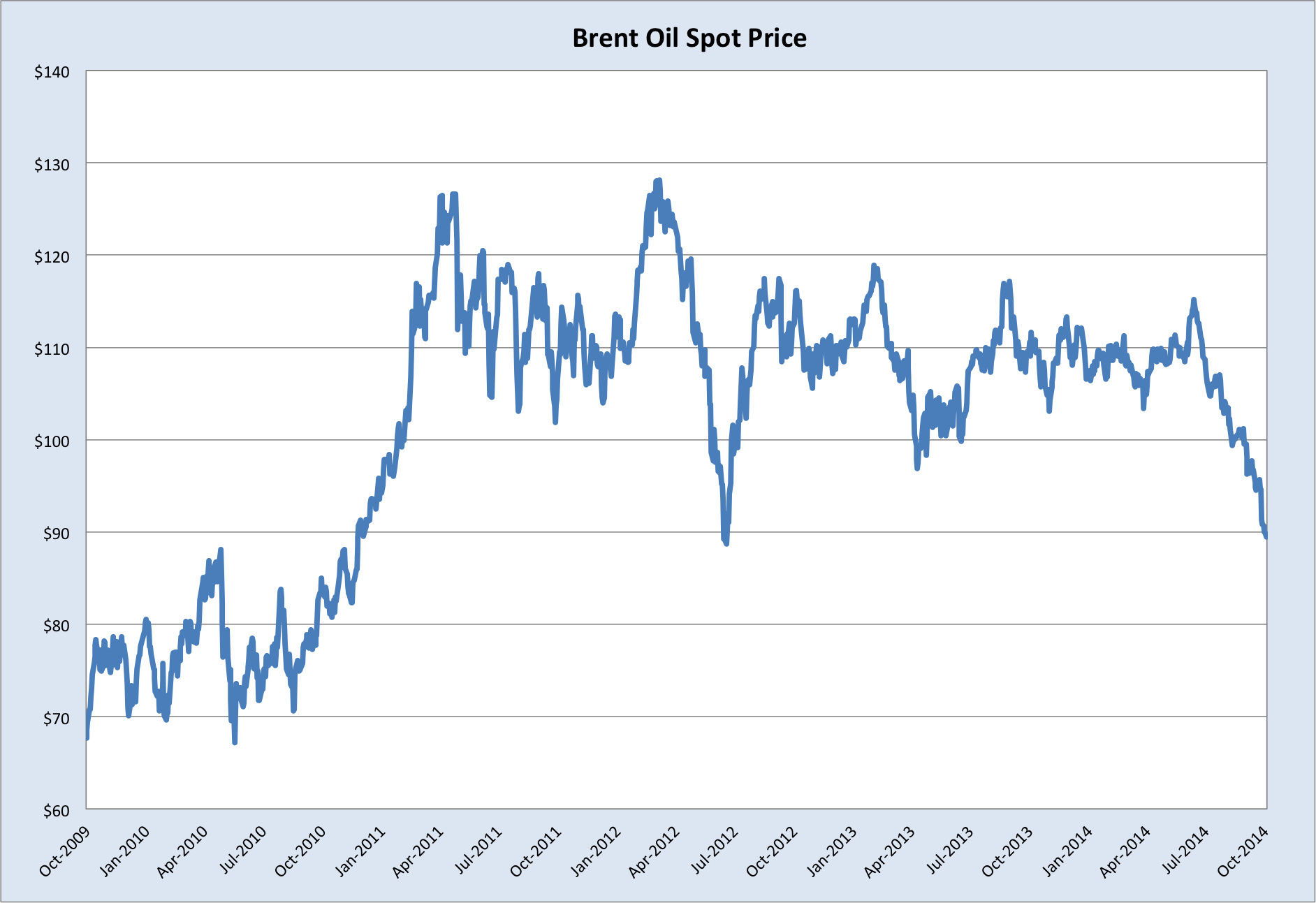
Against the supply backdrop we have anaemic ‘growth’ in Japan and Europe, and signs of a meaningful slowdown in China, giving us a perfect storm battering oil prices.
brentoil

Energy stocks are being crushed accordingly, with the S&P energy sector index yesterday posting its biggest one-day fall since April last year.

The recent surge in US oil production has depended on high oil prices and continuous investment due to the rapid depletion rate of shale wells. This ought to provide a floor of sorts for prices. However, as we saw with natural gas a few year back, producers kept the gas flowing long after they were doing so unprofitably, simply because the cash flow was preferable to shutting down production altogether. This leaves scope for an overshoot on the downside. There’s also the aforementioned situation with OPEC to consider. On the demand side, I see little prospect of a substantial pick-up outside the US. Together with the stronger dollar, this adds up to a high likelihood of more pain ahead for oil.

Equities on edge

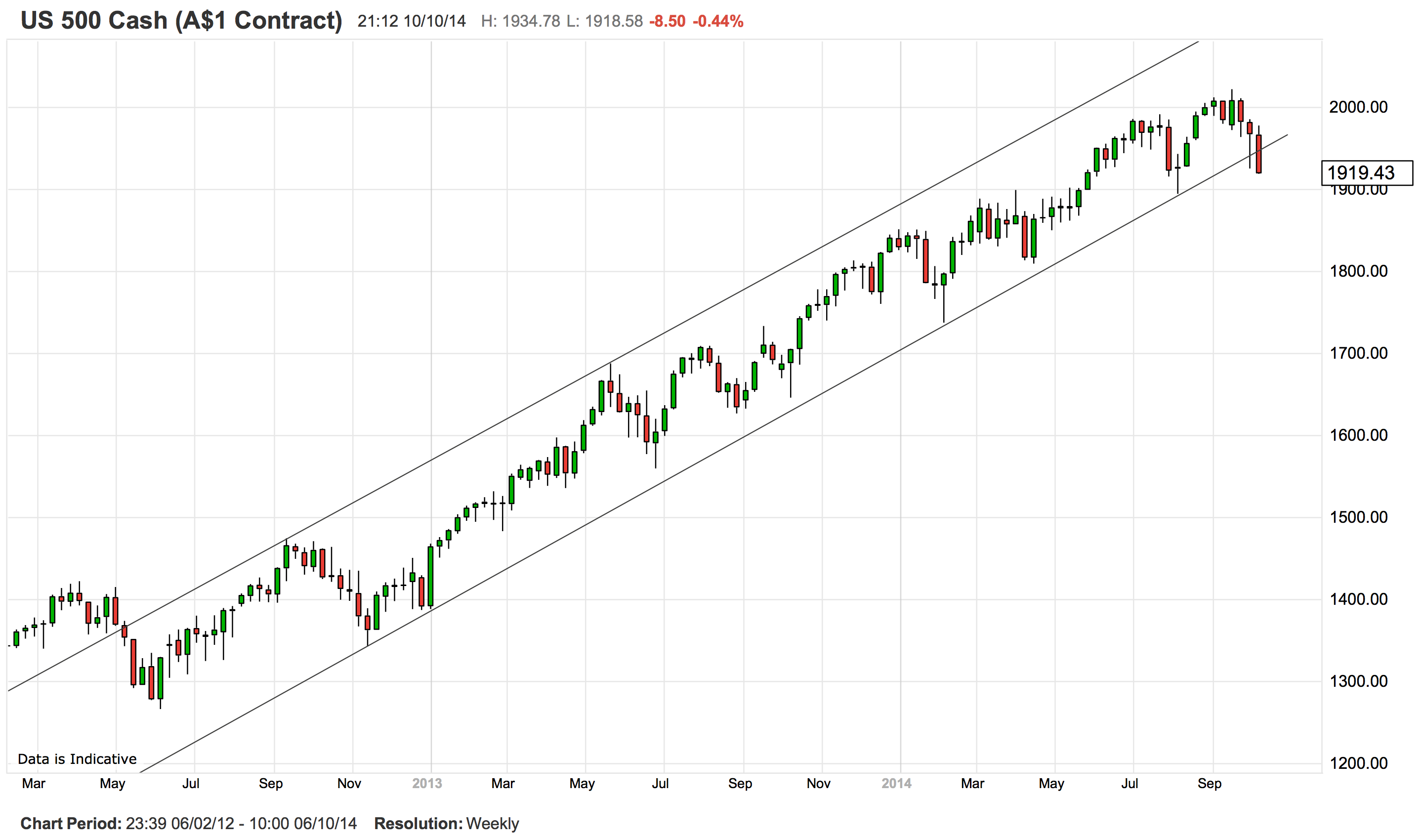
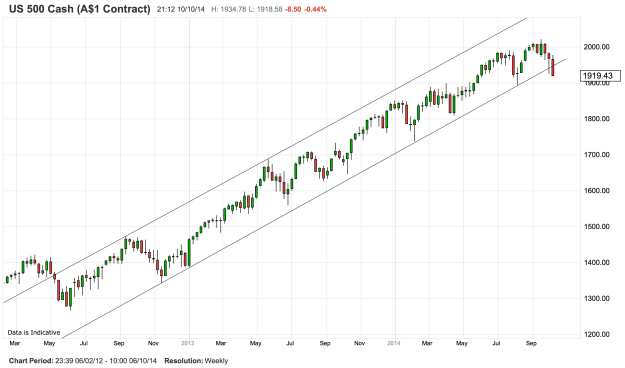
After flirting with the lower bound of its long-term channel earlier this year, the Salt&Peppa has decisively broken through support.
sandpLT

It’s now around 5% off the September high, and looking like it has room for a proper correction (>10% fall).

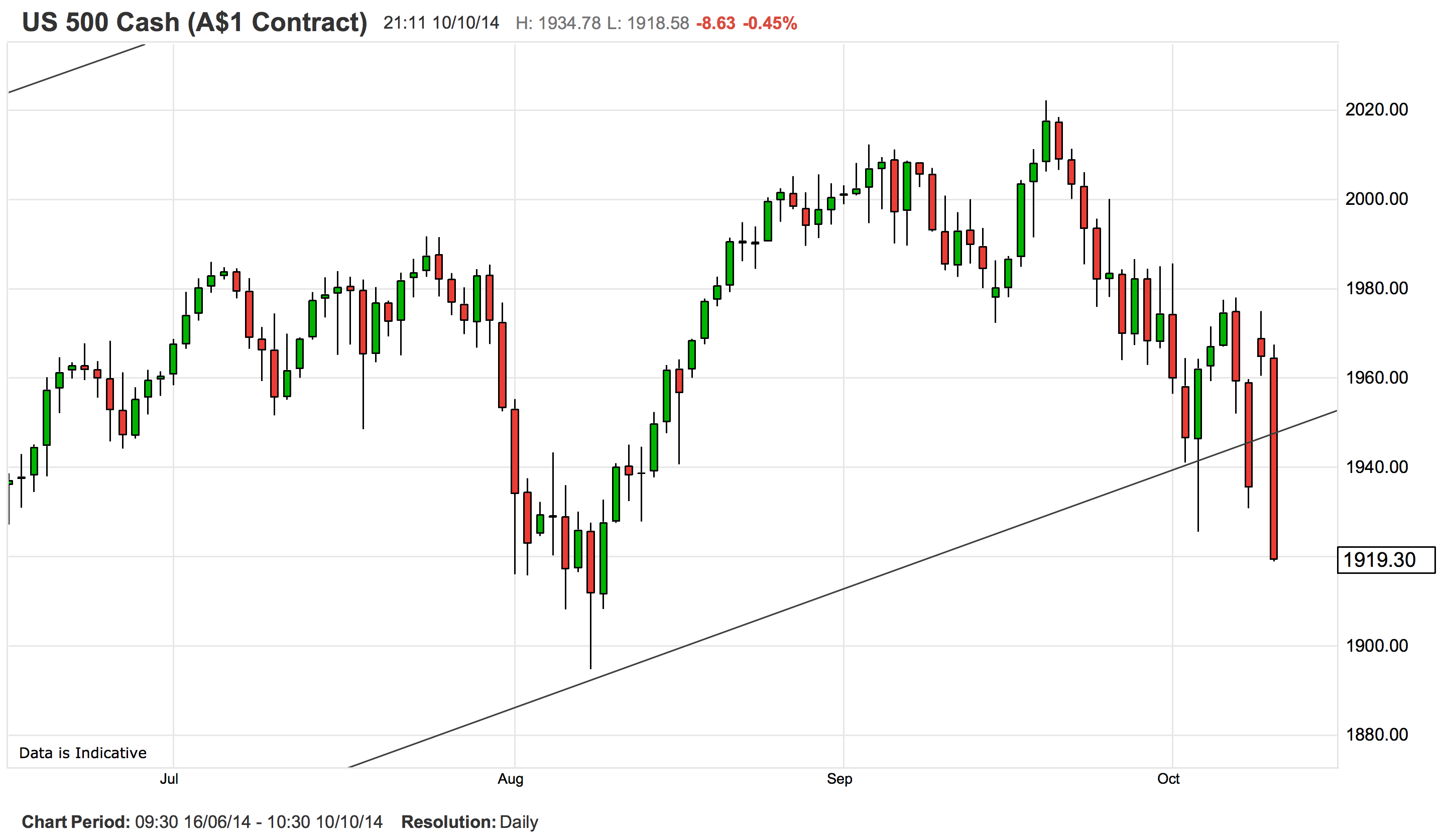
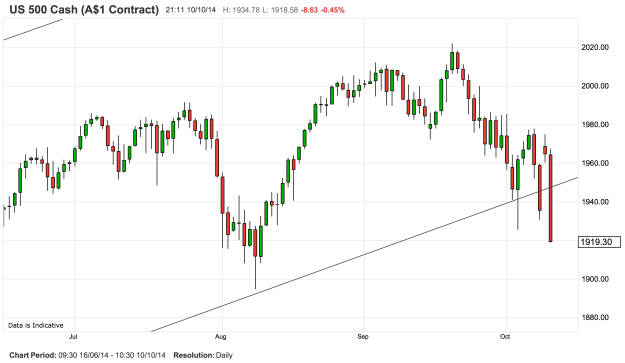
If we take a closer look at recent price action, we get a better impression of how poorly the market has traveled this week.
sandpchart

That’s three breaks of the trend line. The second rally back above support was provoked by the Fed minutes I mentioned before. It was a desperate rally and the swiftness with which it was rejected will be a shot in the arm to the bears.

The IMF meeting this weekend, at which a number of Fed members will be speaking, heightens risk of holding positions into the close tonight. It’s looking as though the various speakers, Vice Chairman Stanley Fischer in particular, will need to pull something generously dovish out of the bag to rescue equities in the short-term.

In some ways you’ve got to marvel at the manner in which this (potential!) correction in equities is unfolding. You’d be hard pressed to find anybody with even a passing curiosity in markets who isn’t aware that QE has supported stock prices. Likewise, every man and his broker has known that the end of QE at least risked a serious dislocation in asset markets. As the great Stanley Druckenmiller put it just over 12 months ago, “How in the world does anyone think when the actual exit (from QE) happens that prices are not going to respond?”

How indeed. Prices are responding just as so many expected them to, but not really in anticipation of the end of QE, but rather right as its happening. It’s a poignant reminder of the level of complacency that accompanies low-volatility, financially repressed asset markets, where the hunt for yield dominates over all other concerns.

Whatever happens with equities in the immediate future, it’s looking as though the days of leveraging up and exploiting yield wherever you can find it, with scarcely a care for the risk involved, is on the way out. With the global growth phantasm fading (again), and the end of QE to boot, markets are set to get much more belligerent and unforgiving.

Volatility is back.

Home sweet home

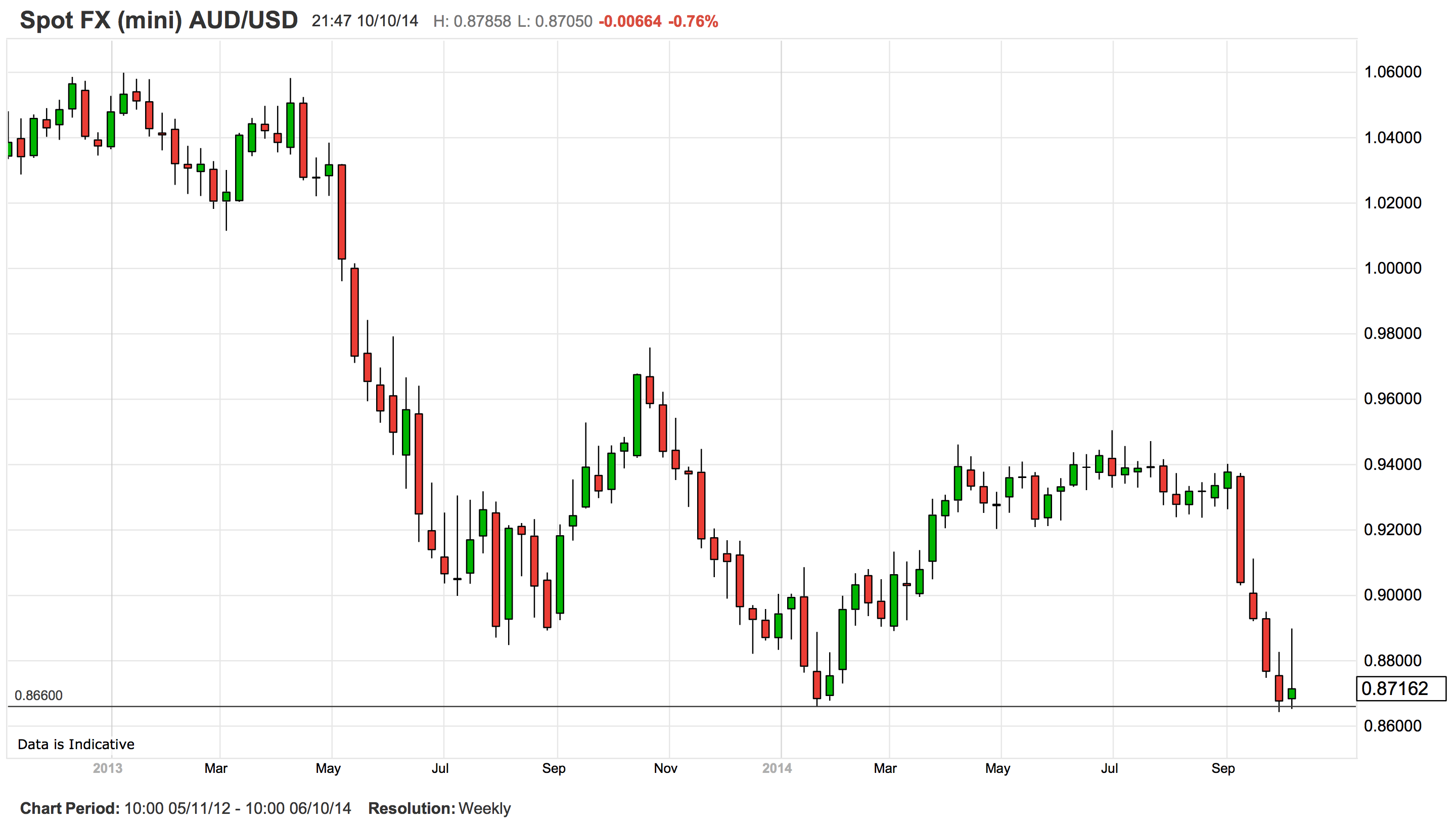
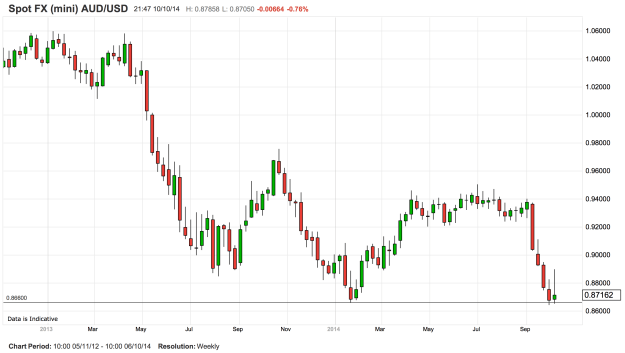
One consequence of all this excitement for us Aussies has been a sharp and most welcome drop in the AUDUSD.
AUDUSD2

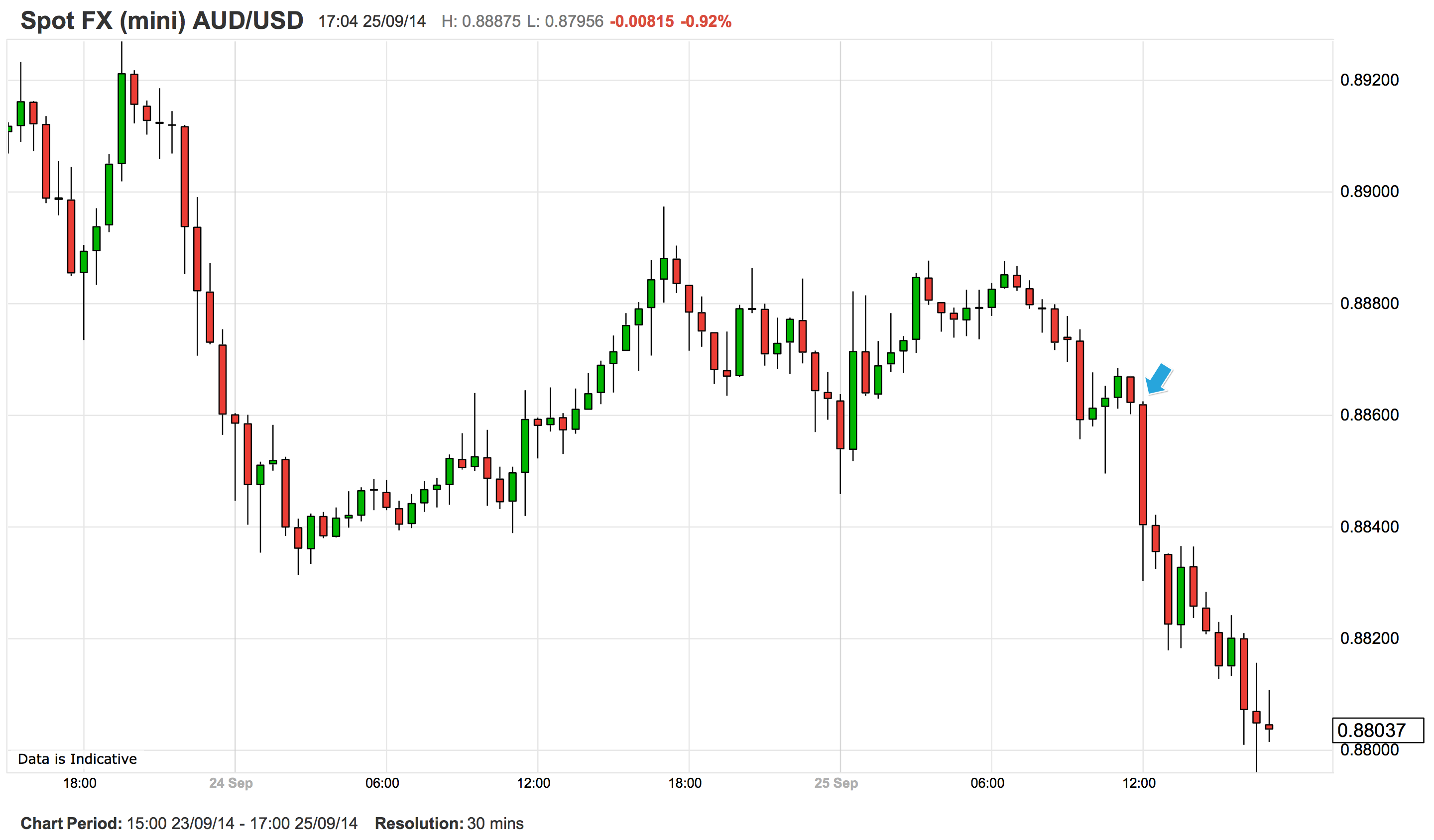
Similar to gold, AUDUSD bounced off the previous low set earlier this year. It then staged a heroic but short-lived rebound, which was smacked down ruthlessly. Hard to see support holding for long.

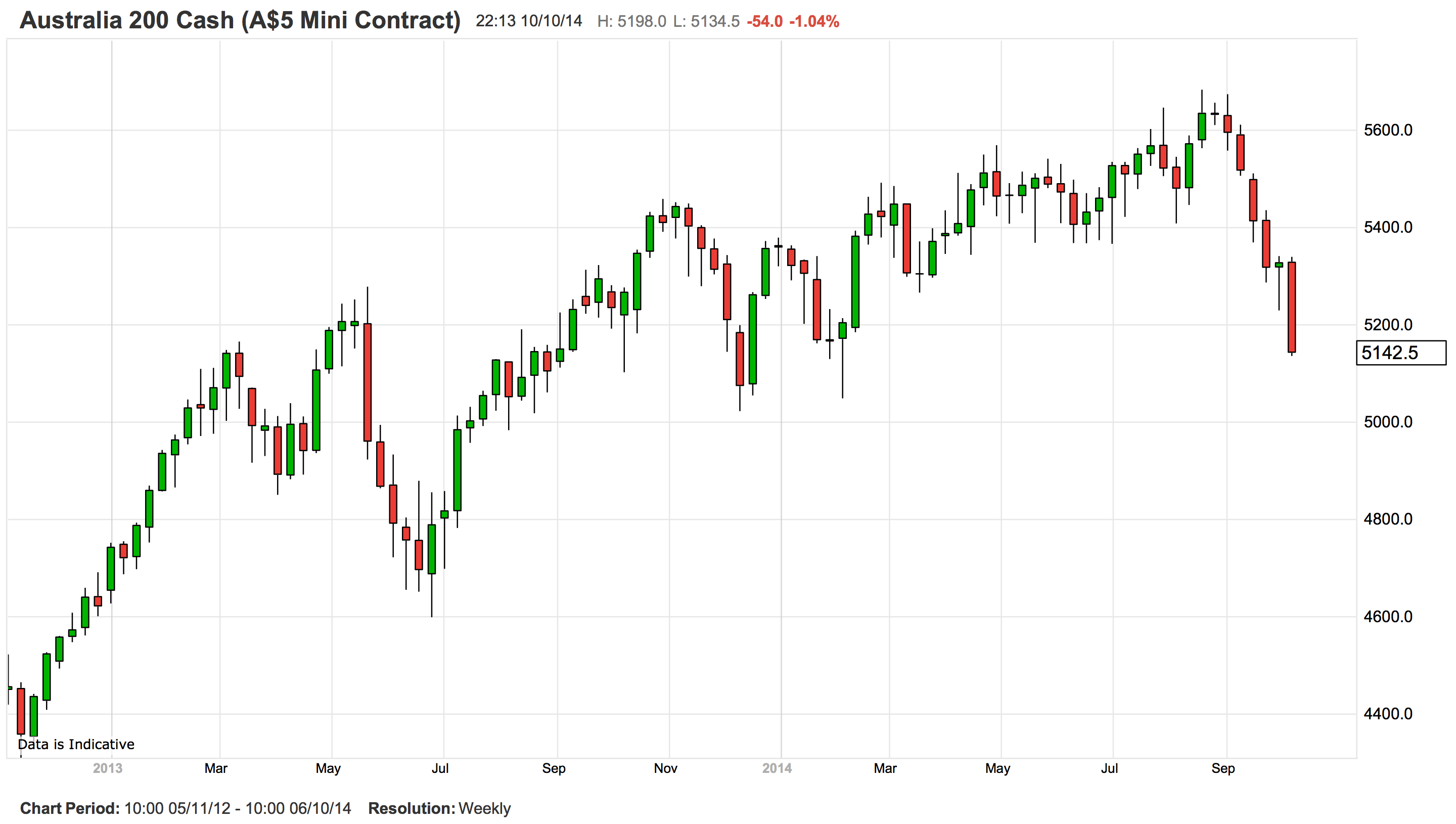
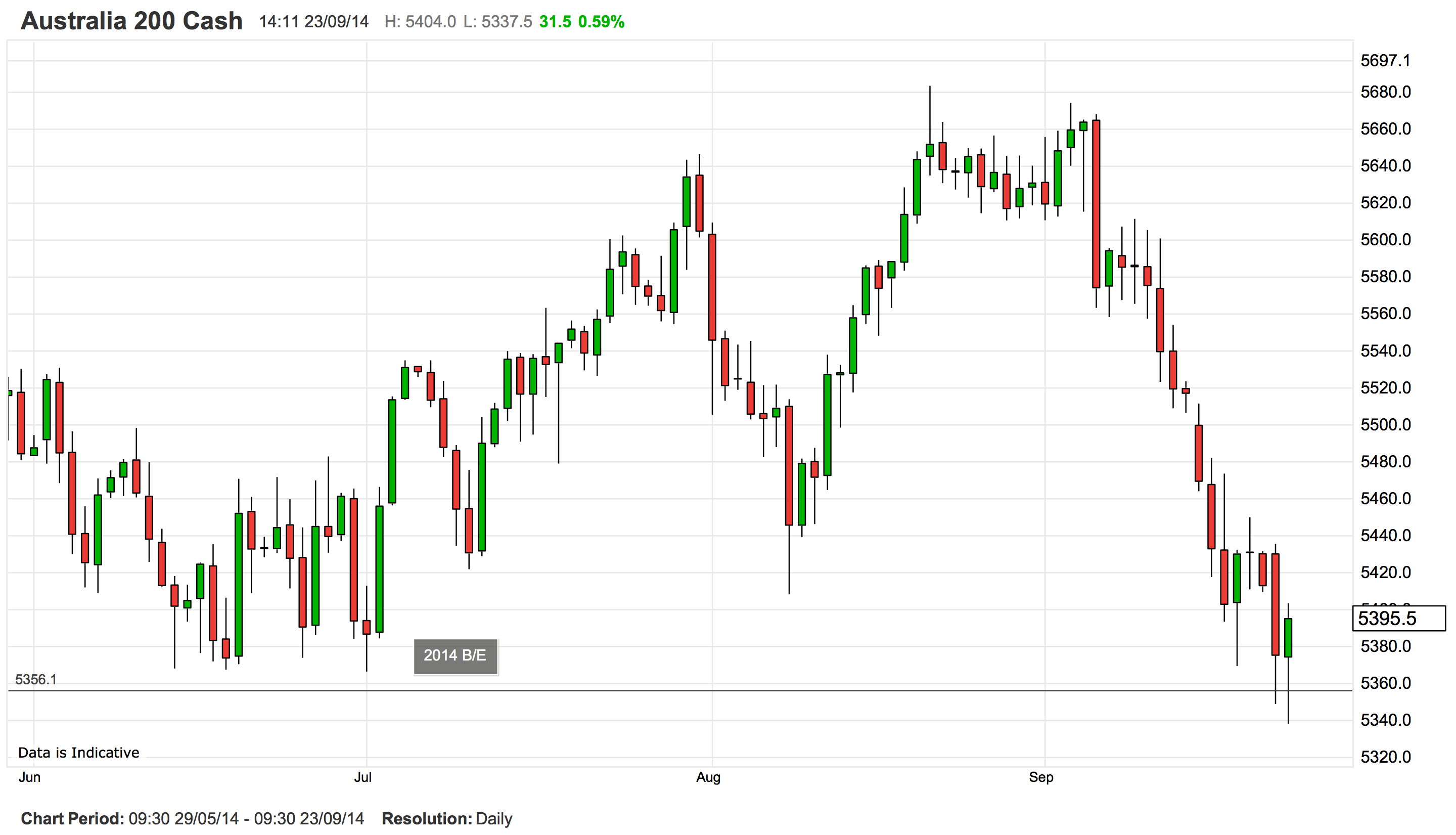
AUD-exposed firms with a strong export profile therefore remain the best prospect among Australian shares. However, I wouldn’t be in any great hurry to rush in, as the downside risks to equities at the moment are palpable. (Note that the chart below reflects after-market futures trading, the close was 5188.)
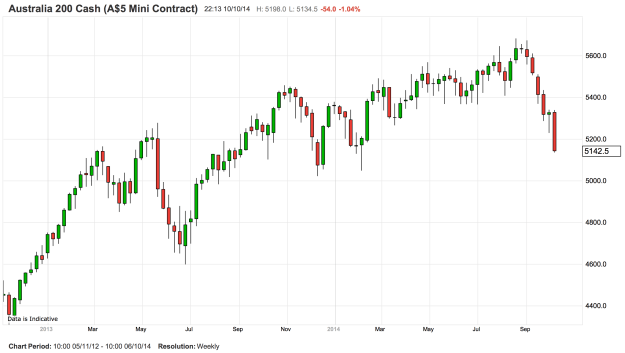
AUS200

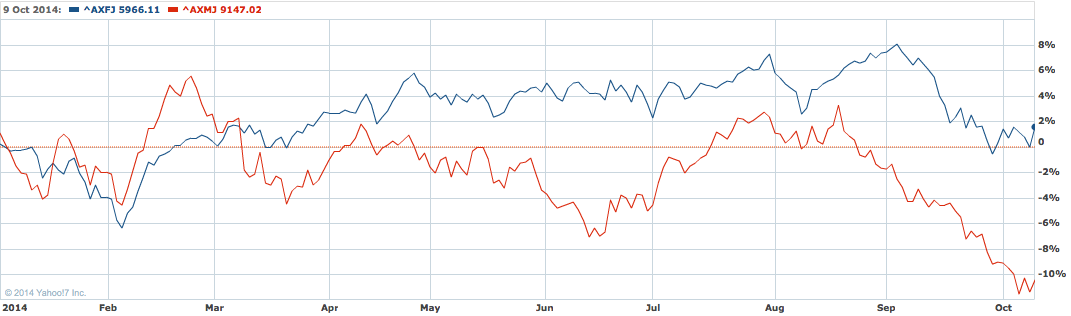
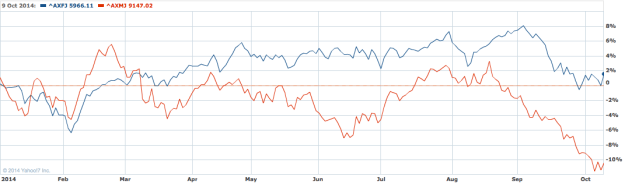
With equities well down for the calendar year now, it’s worth taking a look at the sectoral breakdown within the market.

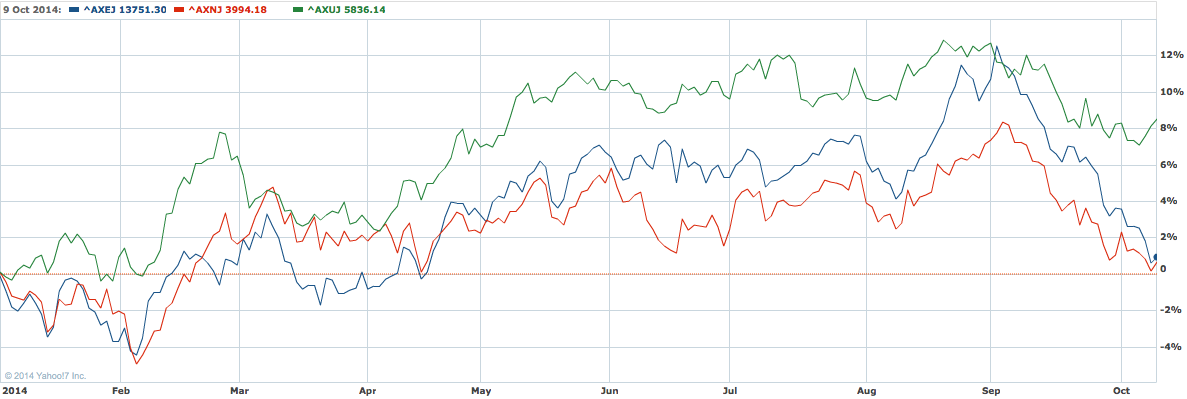
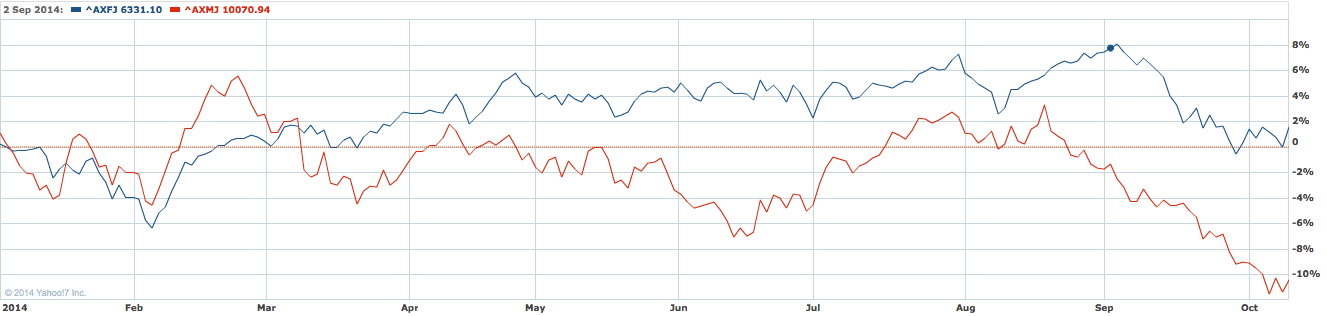
Unsurprisingly, the materials index (XMJ) has been getting pummelled this year. Financials (XFJ) are up slightly but they’ve had a rough ride of late as well, particularly as foreign money hastily bails out of all AUD exposure (which of course has hastened the AUD slide).
Screen Shot 2014-10-10 at 10.09.46 pm
Charts built using Yahoo Finance

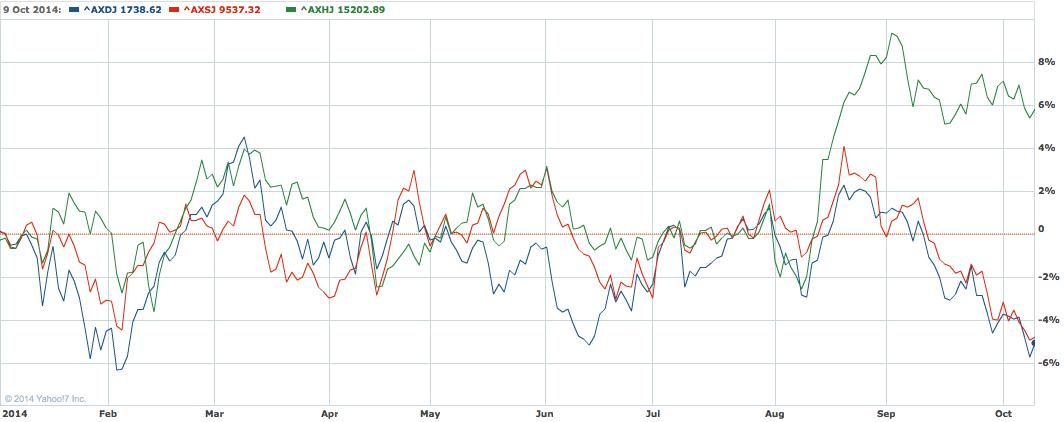
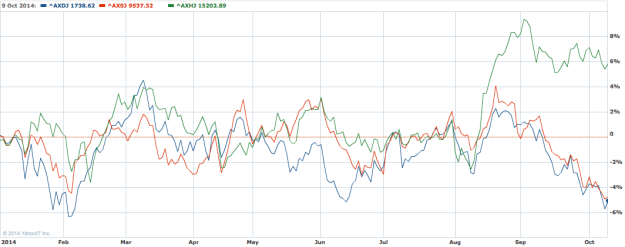
Both consumer staples (XSJ) and discretionary (XDJ) are down year-to-date, and this is reflective of lacklustre consumer sentiment and subdued retail sales post-budget. Health stocks (XHJ) are looking healthy, although that’s almost entirely because of CSL’s rally in August after its profit beat and buyback plan announcement (CSL is roughly half the index).
Screen Shot 2014-10-10 at 10.09.09 pm

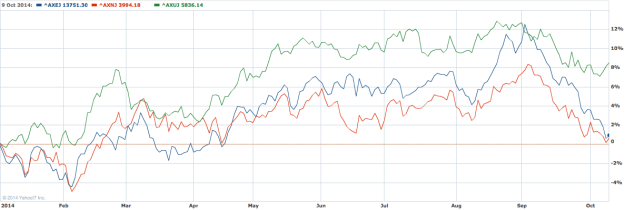
Industrials (XNJ) have mostly sold-off in sympathy with the market since early September. Energy stocks (XEJ) briefly joined utilities (XUJ) as the star performers of 2014, until the collapse in oil prices spoiled the party. This leaves the humble XUJ as the stand-out sector so far in 2014. The driver of the strength in the utilities space this year has been natural gas pipelines operator, APA. As Australia prepares to ramp up its LNG exports, APA has been in the box seat to exploit bottlenecks in gas transportation networks. Even after the recent broad market selloff, APA is still up around 20% for 2014.
1

Steel-ore complex

Better price action for steel and iron ore today in China, with the most-traded rebar contract up 1.6% and Dalian iron ore up 2.3%. More in the usual place.

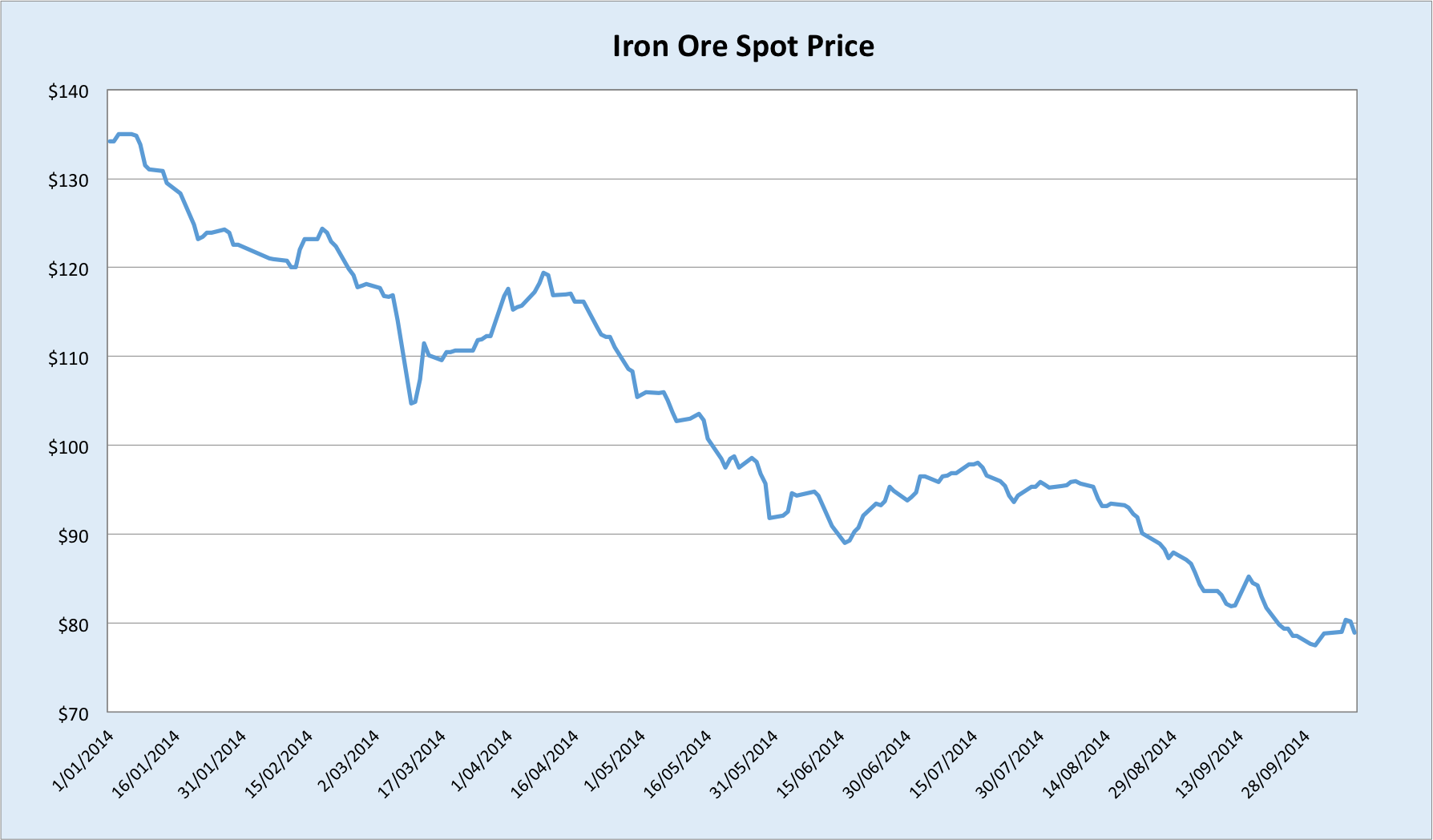
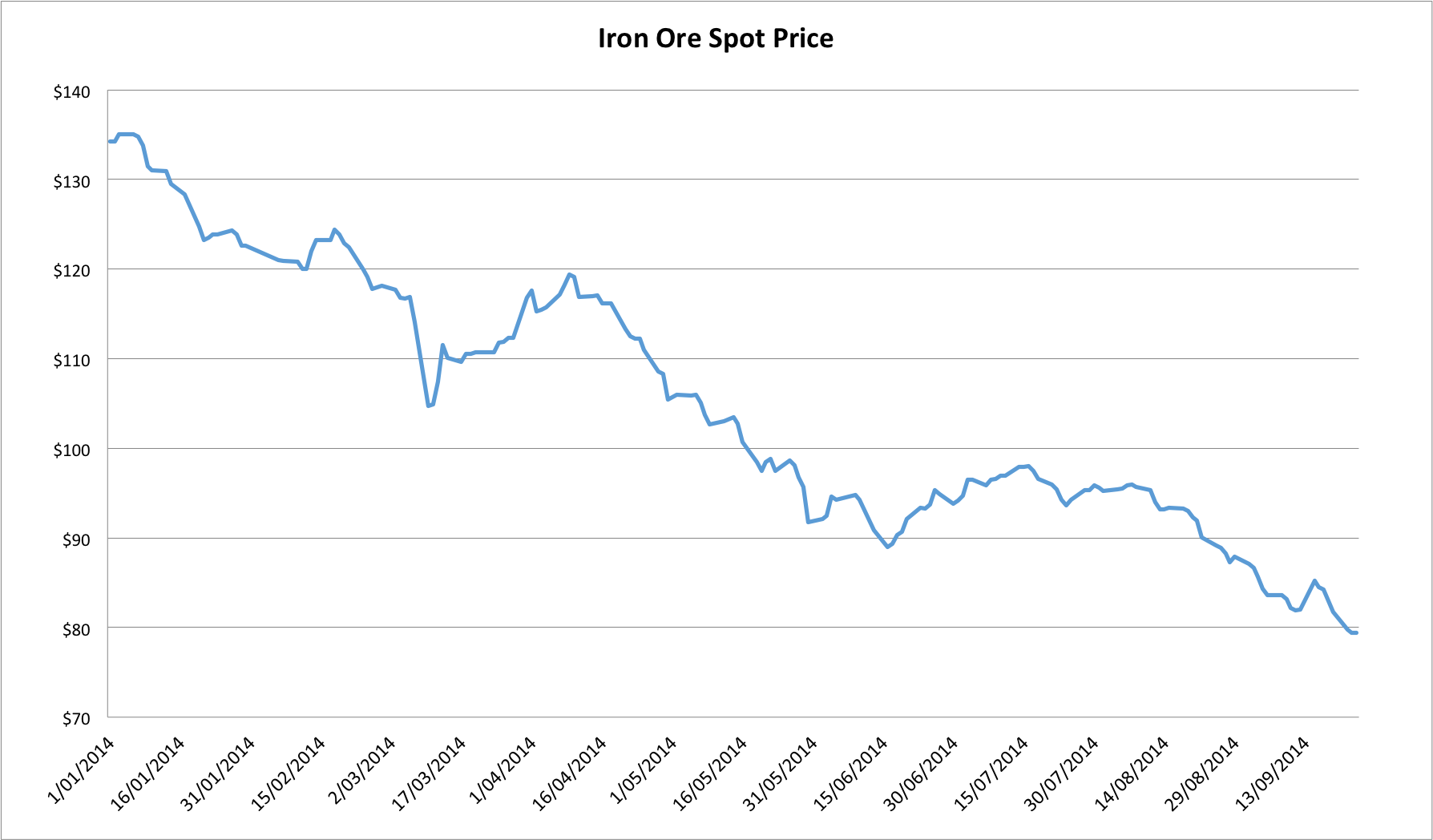
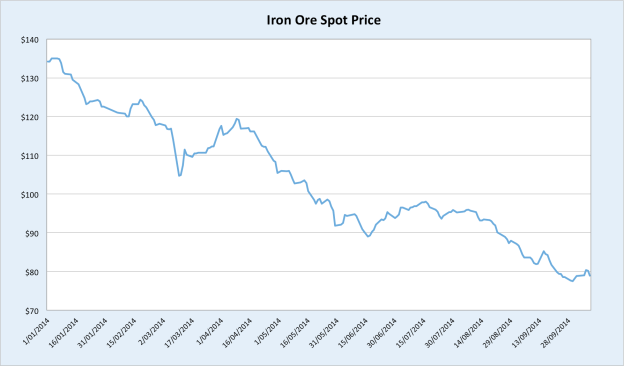
Here’s what spot is looking like at:
Iron ore3

Still fishing for a bottom.

There has been a noticeable thawing in the policy stance towards property in China recently, and if this helps property prices stabilise then it could provide the impetus for a bit of restocking by steel mills, bestowing upon us the fabled Q4 rebound. The trouble is, along with steel and iron ore, property is oversupplied to a degree it hasn’t been in the past; it’s going to take a truly massive credit splurge to reboot the bubble now. And all signs indicate the government isn’t stupid enough to do that.

Still, the worst may well be past for the iron ore miners in 2014. But they’d better pray the AUDUSD has fallen hard by the time the pain resumes in 2015.

The sorry state of Strayan stats

f847edaa52c78f230297514140adc672

Last month’s seasonally-adjusted jobs figure was wonderful, except for the fact that it didn’t pass the laugh test. As I said at the time, I more or less ignore the seasonally-adjusted roulette wheel and focus instead on the trend data, which seem to provide the most reliable reading on the health of the labour market. But the volatile seasonally-adjusted figure still presents a troubling breakdown of respectability at the ABS.
Yesterday they acknowledged as much. The 120k jobs supposedly created in August was an adjusted figure based on seasonal patterns which the ABS believed were present this time of year. Yesterday that figure was revised down to a more-believeable 32.1k, as the ABS has decided that seasonal influences of past years aren’t exerting themselves in 2014.

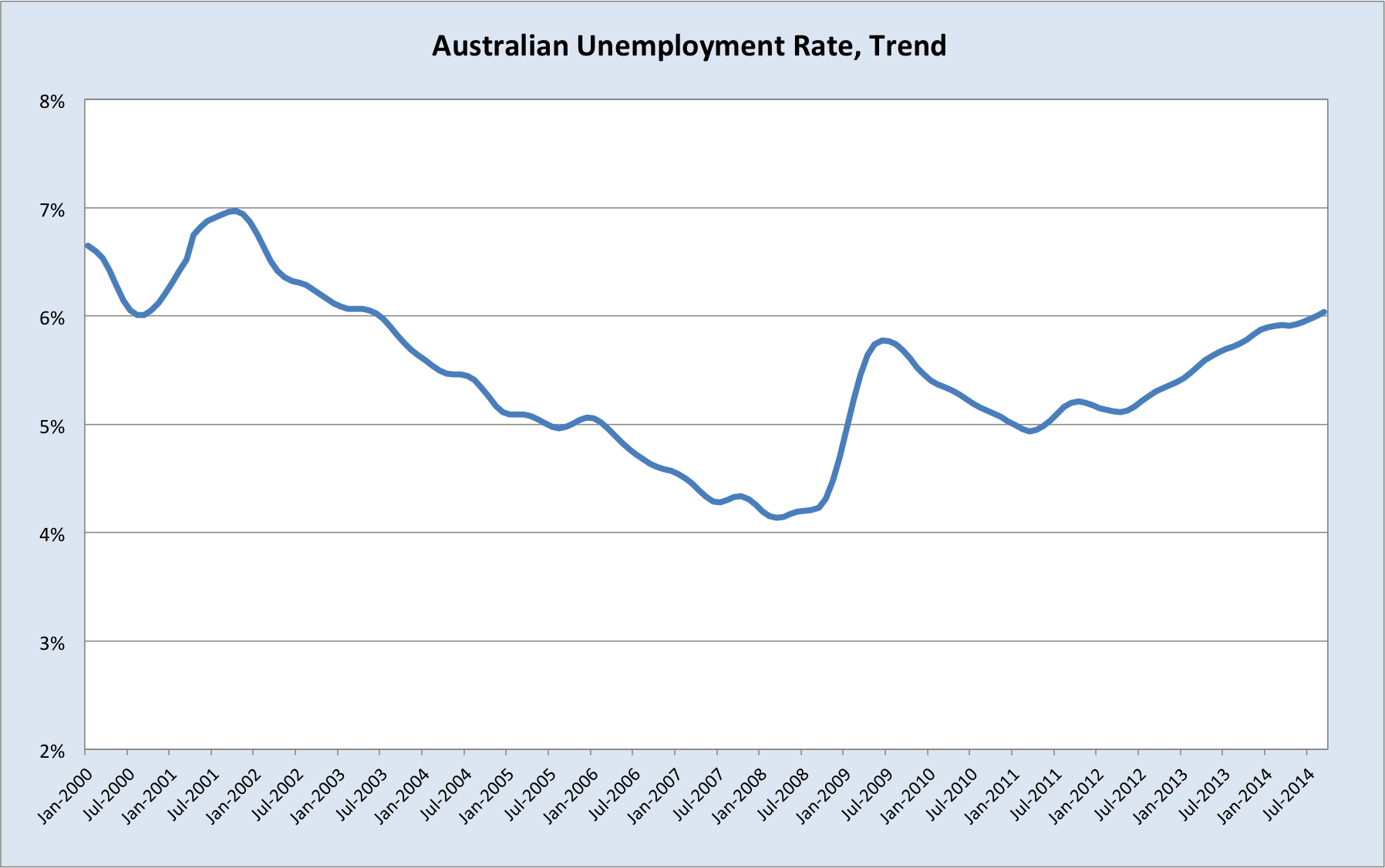
Here’s the latest reading on the labour market. The revised jobs gain last month has been largely wiped out, with a seasonally-unadjusted 29.7k jobs lost. The unemployment rate ticked up to 6.1%. 5.6k jobs were created on a trend basis and the unemployment rate held steady at 6%.

Oz_UE rate

The ABS isn’t exactly sure why previously observed seasonality is not showing up this year, however the following possibilities were offered:

It could have resulted from one or more factors including changes in ‘real world’ labour market behaviour, changes in the timing and content of the supplementary survey program (run in conjunction with the Labour Force Survey), the introduction of web-forms, the introduction of the new labour force questionnaire, or refinements to collection procedures.

Given the sudden shift away from the usual seasonal patterns, the ABS has determined that the usual seasonal adjustment process, based on patterns in previous years, is not appropriate for application for the most recent months’ estimates.

As such, they’ve set the adjustment factors to one for July, August and September, meaning no change has been made to the original data to reflect seasonality. If this sounds as though the ABS is groping about in the dark, then you’re on the same page as me. Only about .32% of the labour force is captured in each survey, which is fine, that’s how statistics works, but it bears remembering that any deficiencies in the collection and organization of the sample, either through incompetence or inadequate resources, can easily screw around with the output.

It certainly appears as though the problems at the ABS stem partly from a lack of resources. Both the current and the previous government have sought to reduce funding and squeeze greater efficiency out of the ABS. Whether this is the chief cause of the labour force survey woes, I cannot say. However I can say with no uncertainty that one of the proposed solutions to this problem would be bad news for Strayanomics. According to Hockey, a user-pay system for ABS data is “one of the things we’ve been actively looking at and I’ll be taking initiatives to cabinet in the next few weeks.”

The ABS has a budget of a little under $400m. This is less than .1% of the Federal government expenditures. I am quite aware of the pressures on the Federal budget, indeed I have been pointing out for some time that they are in considerably worse shape than many commentators recognize. There are many bones of contention when it comes to the current government’s strategy for reducing the deficit, and these are mostly political questions around which segments of society should be targeted for tax hikes and spending cuts.

Perhaps some would disagree, but I do not consider adequate funding of the ABS to be a debatable political issue. Access to sound economic statistics is paramount to the government’s entire macroeconomic policy mandate. The ability to craft and implement effective macroeconomic management is all the more difficult if you don’t have the clearest picture possible of conditions in the economy and the outcomes of policy choices. So while it’s hard to see the government allowing further funding pressures to hinder the ABS, adopting a user-pay model to access the bureau’s data would be a regrettable solution.

Firms are afforded free access to ABS data and may use it for research purposes to generate revenue. They would be inclined to pay for that data, assuming it is integral to their business. For a blog like Strayanomics, with no suggestion of it generating revenue except in moments of pure jest, I can tell you it is a pain in the ass trying to get data at the best of times. Publicly available statistics are therefore the life-blood of amateur analysis. They offer any interested citizen the means to check for themselves whether the pronouncements of the media or politicians bear any resemblance to reality.

Discouraging such inquiry by charging for basic information about the state of our nation would be a sadly regressive step; a blow to the Open Society.

RBA Statement

No change in the cash rate today, as expected.

Here’s the full statement.

Some takeaways:

  • Chinese property a drag (albeit it with strong indication of a changing policy stance, whether it is effectual remains to be seen)
  • Volatility up globally, though still not elevated by any means
  • Mining investment is declining offset by a pick up by ‘other areas’ of private investment (other areas mostly being residential property construction)
  • Labour market data have been all over the place lately, conditions aren’t dire but softness remains (a great share of recent job creation has been centred on property construction)
  • Monetary policy is loose. Overall credit growth is moderate but being driven by housing investors
  • Exchange rate is down, but not far enough given the drop in commodity prices, and has further to fall to lift the moribund tradable sectors
  • Wage growth is more or less nonexistent, and inflation not concerning (appears RBA is happy to ‘look through’ a rise in import prices as the currency falls in value, rightly so in my view)
  • On present indications, the most prudent course is likely to be a period of stability in interest rates.

Nothing to get too excited about either way at this stage.

As I said when I launched this blog and soon thereafter began a series on Australian interest rates:

In a country like Australia, changes to interest rates tend to be quite effective in influencing economic conditions. Lower rates stoke borrowing, asset prices and consumption, giving way to higher rates, and vice versa. Why then are we drifting across a calm blue ocean of low interest rates?

Primarily due to the uneasy schism that has emerged in our economy. On the one hand we have the descent from what has almost certainly been the biggest terms of trade/investment boom in our nation’s history. On the other we have a raging house bubble boom. Which force prevails in this struggle will determine the short- to medium-term direction of interest rates.

For now, the RBA is happy to sit and wait for further indication of which force is gaining the upper hand.

Straya T’day 7/10/2014

RBA day

Well, what a day to return to the world of econ after a long weekend of agreeable company and responsible drinking.

The Treasurer has acknowledged that the terms of trade bust is likely to weigh heavily on the budget in the years ahead, which seems to have spooked bank stocks (Australian banks funding costs are dependent on the health of the public balance sheet). Although I am in agreement on the outlook for commodity prices, it’s worth bearing in mind that the budget in May expected the Australian dollar to remain at .9300 against the USD. The large falls in the AUDUSD during the past couple of months will therefore help to cushion the impact of the prices for key exports (by supporting company tax revenues).

The RBA will chime in shortly with its view on the state of the economy. There’s effectively zero chance of the RBA changing the cash rate today, meaning my dovish forecast will survive another month.

Perhaps the most impactful development in the last couple of weeks has been the RBA’s Damascene conversion to Church of Macroprudential (see here also). Bloomberg picked up the story on the weekend, with RBA Makes Hawks Cry With Turn From Rate Tools: Australia Credit

The article quotes forecasters who’ve pushed out their expectations for rate hikes due to the change in policy from the RBA.

TD Securities and AMP Capital Investors Ltd. joined traders in drawing back from forecasts for early rate increases in response to policy makers’ hardening rhetoric on curbing mortgage lending to housing investors. RBA Governor Glenn Stevens is forecast to keep the benchmark unchanged at a record low tomorrow.

It is indeed true that the RBA’s adoption of macpru tools, if they prove successful in cooling the investor housing feeding frenzy, will reduce the need for higher rates. To recap my well-worn view on Strayan rates: the unfolding terms of trade shock and the decline in mining investment are currently jostling with a robust housing sector, concentrated especially in Sydney and Melbourne, for primary influence on the short-term direction of interest rates. So if the RBA can find ways to take the froth out of the housing market without raising rates, this favours interest rate doves.

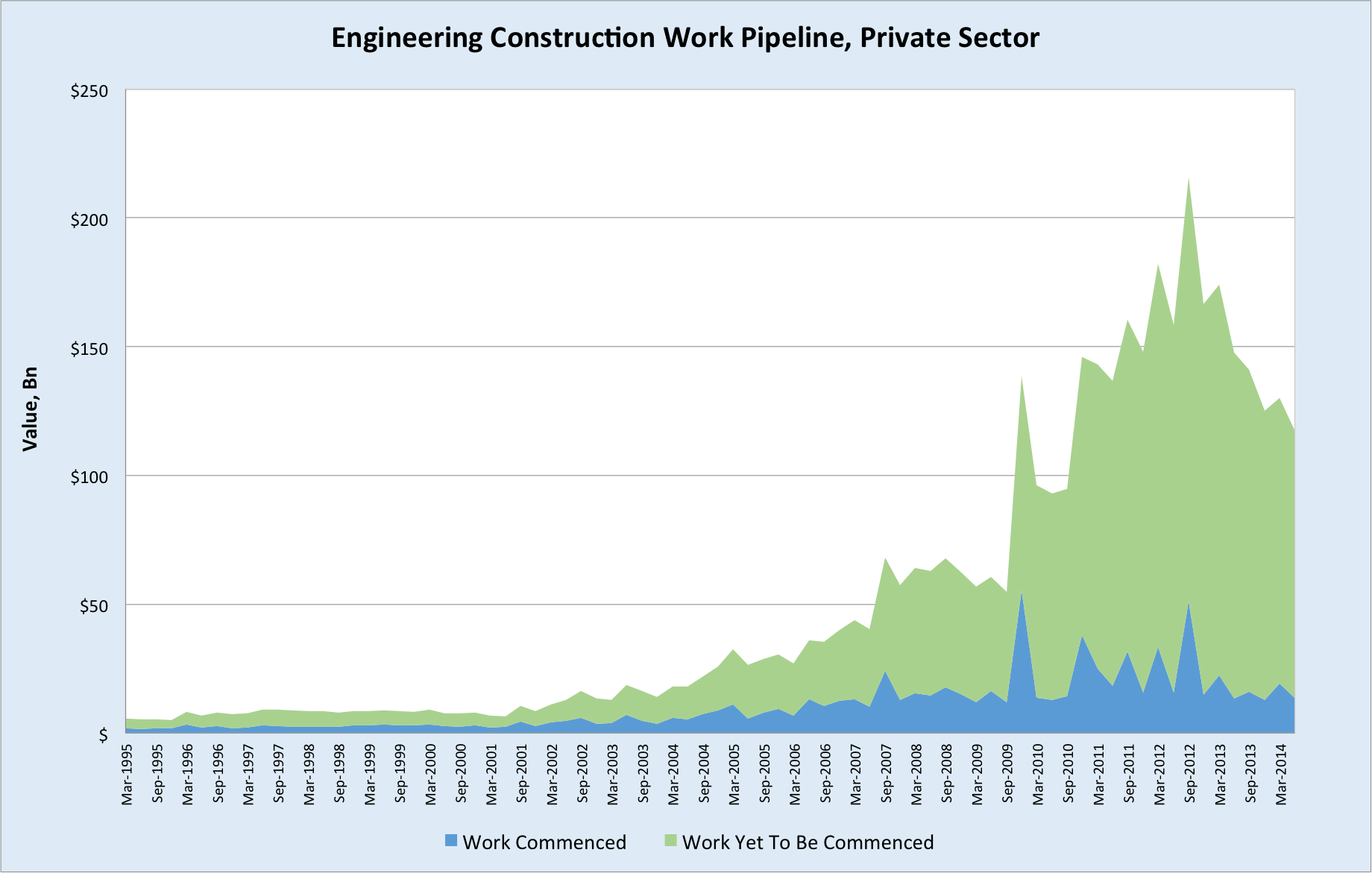
We know what the situation looks like for iron ore and mining investment.

Untitled2

EngineeringWorkPipeline

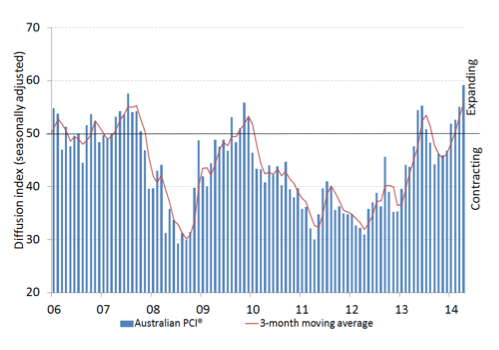
Turning to the bullish influences, activity centred on the property sector is clearly very strong at the moment, as we can see this in the latest reading on construction activity from the Australian Industry Group.

Screen Shot 2014-10-07 at 12.17.19 pm

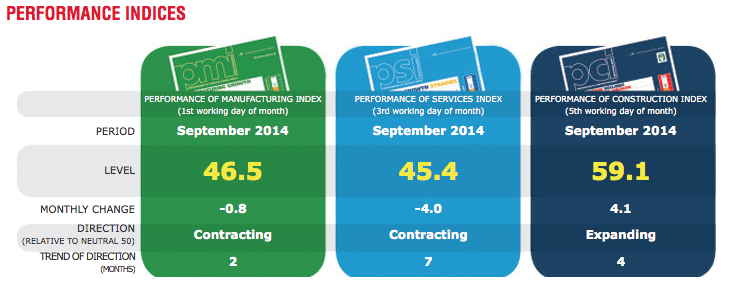
Unlike the manufacturing and services sectors, construction is charging (above 50 indicates expansion):

Screen Shot 2014-10-07 at 12.13.24 pm

It is good to see a supply-side response in the property sector, since structural supply constraints have hampered the market for years. But it must be remembered that this cannot sustain the economy indefinitely. Once a house or apartment is built the positive impact on the economy has mostly passed. Of course, it provides a place to live, but living in an apartment doesn’t support jobs; building it does. Therefore other sectors, especially the non-mining tradable sectors, need to be revitalised to fill the void left by the declining terms of trade and support jobs in a sustainable manner. To achieve this means substantially lowering the real exchange rate. Raising interest rates now would severely diminish the prospects for a continuation in the currency’s fall, and make the goal of a lower real exchange rate all the more challenging.

It would be nice to suppose some excitement will be injected in monetary policy after soporific missives from the RBA, but I suspect they will be content to stand pat for the rest of the year for some time yet.

Straya T’day 30/9/2014

Softness in Asia

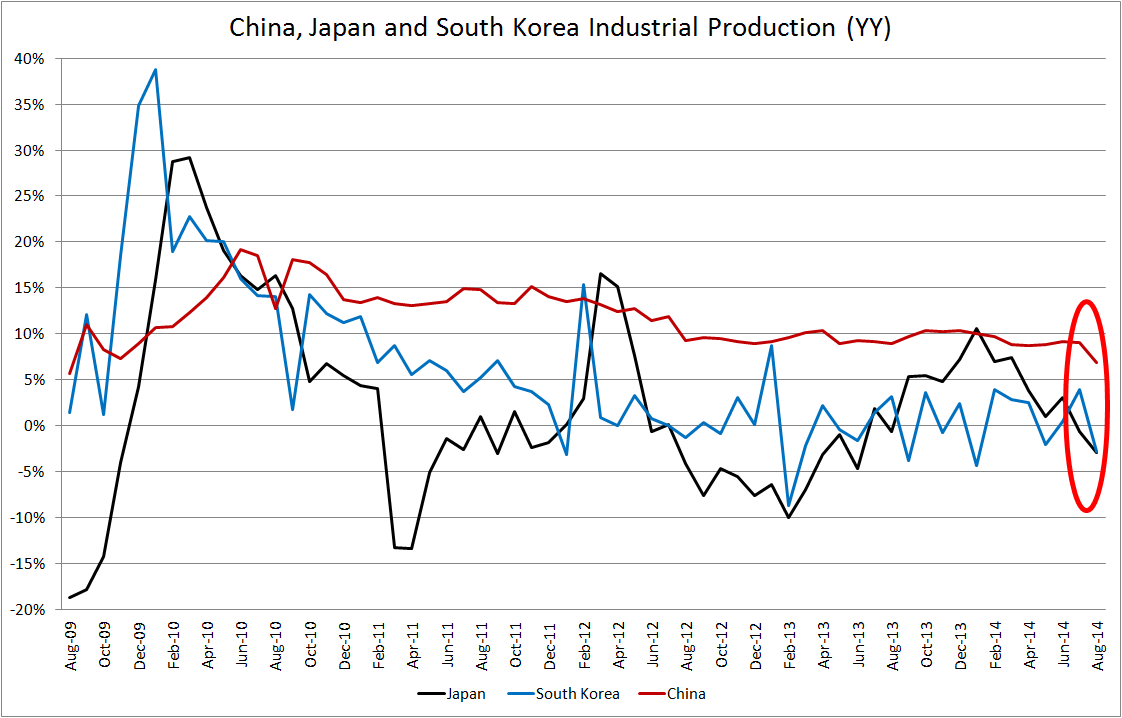
August Industrial production (IP) figures were released today for South Korea and Japan, and both were weak; -2.9% for Japan and -2.8% for Korea, both year-on-year. Close to a third of Korean exports and one fifth of Japanese exports go to China, so the recent slowdown in Chinese industrial production and surprise fall in profits are likely to be contributing to regional weakness. This chart from David Scutt paints the picture:

soft-ip-partners

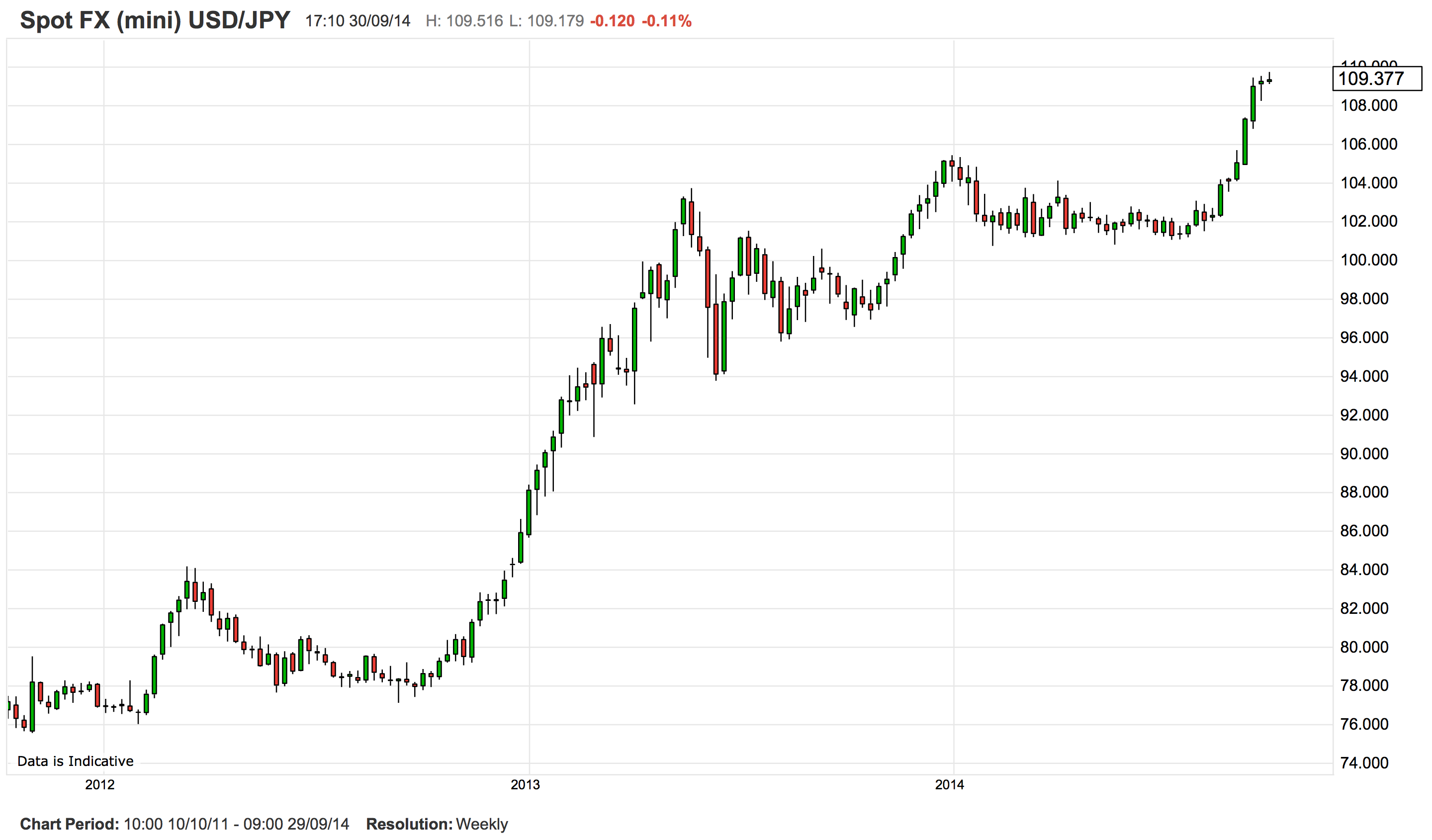
Apart from the always-suspicious absence of volatility in Chinese figures (the latest print did buck the trend there, I suppose), the trend in Japanese IP is clearly of concern. The rebound in IP in 2013 occurred largely as a result of a massive depreciation in the yen, seen in a 33% rise in the USDJPY between late 2012 through to the end of 2013.

USDJPY2013

Two things happened this year; until August the yen was broadly flat, and in April the government raised the sales tax. Since the sales tax hike, IP has fallen in 3 of the next 5 months (month-on-month).

The USDJPY has rallied hard in the past few weeks. It remains to be seen if this can invigorate Japan’s languid industrial sectors. It will undoubtedly help at the margin, but a larger unknown is the outlook for Chinese production, which is of course mostly dependent on the ‘will-they-or-won’t-they’ stimulus outlook.

On a related note, there was a good article in last week’s Economist on Japanese and Korean firms’ tendencies to hoard cash to the detriment of their economies. At the very least, if corporates are concerned with their competitiveness and reluctant to raise wages, dividends should be increased. It would provide a welcome boost both domestically and internationally.

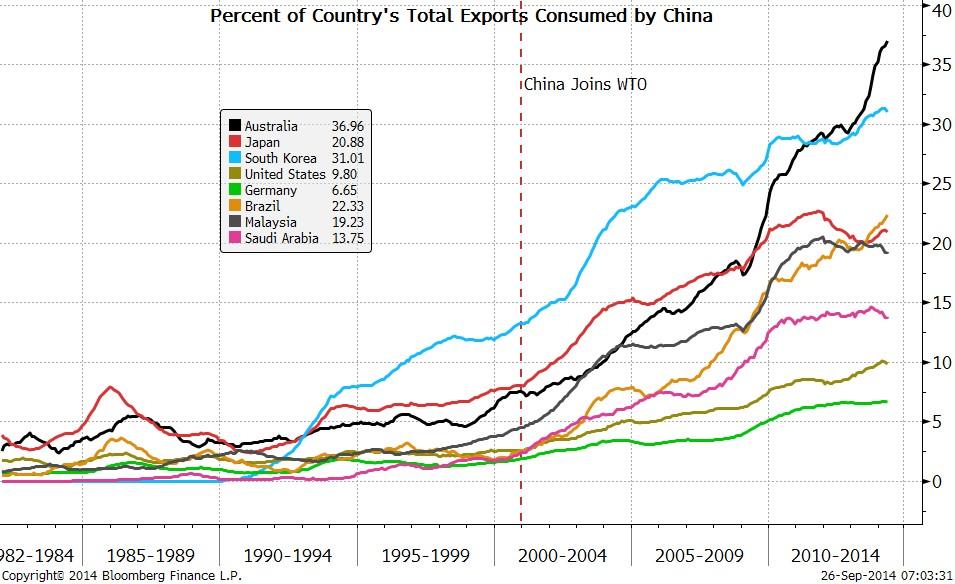
And lastly, while we’re on the topic of a heavy reliance on China, we might as well remind ourselves of some of the other noteworthy countries in that category.

BydFJR3IUAA_wbl.jpg-large
Chart from Michael McDonough of Bloomberg

HSBC PMI not as buoyant as first thought

The final reading of the HSBC PMI for China was released today, and contrary to the earlier ‘flash’ estimate which had it rising to 50.5 from 50.2 the month prior, it was actually unchanged. While it is welcome to see this figure in positive territory (having spent much of the past two years in negative), the tepid expansion is only being realized via strong export orders.

As I said at the time of the flash release, the strength of exports is likely to be in partly underpinned by Chinese steel mills dumping their unsold stock into global markets, where they can achieve a much higher price than in China. This is of course vulnerable to protectionist responses from governments should their local steel sectors grow tired of ‘making room’ for heavily discounted Chinese steel products.

Moreover, from Australia’s point of view, it is hardly reassuring that the Chinese steel sector is facing such lacklustre demand locally that it is being forced to turn offshore with increasing urgency.

Steel-ore complex

Chinese steel futures retraced their gains late on Friday, and iron ore finished the week flat after looking like finding some buyers during the day. Protests in Hong Kong weighed heavily on prices at the open yesterday, though they gained somewhat throughout the session. Spot iron ore finished last night at $77.70, off 1.15%. It is now down 42% for the year in USD-terms, and 40.80% in AUD-terms. The recent decline in Australian dollar (or rise in the USD, really) has therefore come at a welcome time, though there is much work to be done on that front.

Untitled

After rallying earlier in today’s session, the most-traded rebar contract closed down .4% in Shanghai today. Dalian iron ore gained .7%. Since markets will close for China’s National Day Holiday tomorrow, spot will need to recover yesterday’s loss to avoid an 8th consecutive week of declines. More from Reuters.

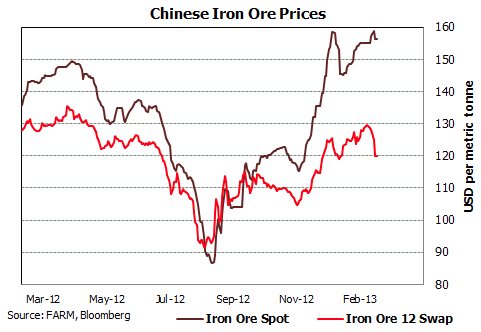
In local news, ex-RIO chief Anthony Albanese has joined ex-BHP executive Alberto Calderon in expressing his scepticism regarding the oft-cited iron ore rebound supposedly arriving later this year (if it comes, late October would be my guess). As a reminder, in Q4 2012 spot pieces soared after collapsing on seasonal weakness, and a similar pattern is seen by some as a possibility this year.

Screen Shot 2014-09-06 at 5.30.50 pm

Of course, I’m in agreement with Calderon and Albanese that we won’t see a pronounced rebound this year (bearing in mind that no one, to my knowledge, is expecting the rebound to produce prices comparable to 2012).

To reiterate, my reasons for this are:

  • India knocked some 100m tonnes of annual supply out of the seaborne market fairly rapidly in 2012 with its ban on mining in Goa, which followed similar restrictions in Karnataka in 2011 (total traded iron ore was about 1100m tonnes in 2012). If memory serves, Macquarie reckoned these moves added about $20 to spot prices throughout 2013.
  • Chinese stimulus via fixed asset investment flowed freely in 2012, and, critically, the property sector commenced a strong upswing around the time iron ore bottomed. Property is moving in the opposite direction now, and like much else in the Chinese economy, oversupply is becoming an issue. It remains to be seen whether the government is prepared to allow this process to run, or whether they cave and unleash another ‘big bang’ stimulus, as many analysts and commentators are now clamouring for. My base case is that the government institutes mild stimulus measures to support overall demand, without igniting another explosion of shadow banking excesses or wasteful fixed asset investment. But it’s roulette really, all you can do is monitor the situation in Beijing closely.
  • Due to a renewed upswing in Chinese demand, the loss of Indian supply tightened a market in which suppliers already held considerable pricing power. As everyone is surely aware, that is no longer the case now, with Morgan Stanley putting this year’s surplus at around 50m tonnes, growing to 150m next year. It has decisively shifted to a buyers’ market.
  • The displacement of high cost supply, which the majors adduce to justify their enormous supply expansions, will help stabilise prices in time. But so far this has occurred much more slowly than anticipated, and I expect this continue and high cost supply to exit only incrementally, rather than in a rapid manner that shrinks available supply and compels Chinese steel mills to suddenly scramble for stockpiles.

Thus, short of a ‘big bang’ stimulus from the Chinese government, the recovery in spot iron ore later this year is likely to be much more muted than in previous years. I still would not be surprised to see it rebound to around the high-$80s, but there is a good chance that the impetus for Chinese steel mills to restock as they typically did in the past just isn’t there now that the market is firmly in structural surplus.

Update

Spot fell to $77.50 today, 8th week of declines, down 12% for September. Again, I’d be surprised so see another monthly decline in October as it usually ushers in restocking activity; it’ll be interesting to see if tradition is upheld this year!

Straya T’day 26/9/2014

Memo to RBA from former self

Former RBA senior economist Jeremy Lawson has delivered a gentle rap across the knuckles of his previous employer for the state of housing, albeit with the insistence that it wasn’t mendacity but rather an underestimation of the ‘investor pulse’ in Australia that led the RBA to sit by while housing market inflated. I have covered the rise of the Australian property investor here, so it goes without saying that I mostly agree with his appraisal.

Much has been written this week about Stevens’ ‘backflip’ on macpru regulation, centred on his somewhat flippant description of these tools as an international ‘fad’, just last month. What he actually said was;

As for what one does about (the boom in property investment in Sydney and to a lesser degree Melbourne), apart from just warning—and the warning is probably ignored—I think the next step is to then press through the supervisory mechanism for the lenders to know who they are lending to, take care, keep giving the message about leverage and take a close look at standards of lending. APRA already has been communicating with banks about those types of issues, and I imagine we can probably step up that scrutiny and make it a little bit more targeted if it is appropriate to do so over time. The strongest step would be the dreaded macro prudential tools—they are the latest fad, internationally. And I have said that I do not rule out the use of those or asking if APRA will use them, if needed. That would remain on the table as a possibility as well.

His choice of words was unfortunate. He wasn’t wrong that macpru policies have gained popularity in the international policymaking community in the wake of the GFC, however this was a necessary response to the catastrophic failure of conventional thinking on central banking and macroeconomic management that resulted in the crisis. So macpru is no fad, at least I certainly hope it’s not. But despite his seemingly dismissive tone, Stevens clearly had not ruled out the dreaded macroprudential tools.

Returning to Lawson’s comments, the one criticism I think can be fairly levelled at the RBA over its lackadaisical approach to housing is the failure to learn from recent history both here and abroad. As I have detailed previously, the past two decades have deeply implanted the notion in many Australians that property speculation is a low-risk, high return investment strategy, and understandably so. There have been persistent warnings of the dangers of leveraged property bets, and none of these ‘doom-mongering’ exhortations have been vindicated (remembering, of course, why this has been the case). Therefore, as the RBA pushed the real cash rate into negative territory, it should have been acutely aware of the high probability that this would ignite another investor surge in the property sector. It would have been entirely appropriate to deploy some manner of macpru tools before the cash rate was dropped as low as it was. Whether these would have worked, we do not know. But as Stevens has belated accepted, there was little downside in trying.

Shining lights in the darkness

Michael Pascoe and Adam Carr have both come out swinging as a mood of foreboding supposedly descends upon the nation. Carr is sounding increasingly unhinged as he lambasts everyone from ‘property doomsters’ to our esteemed policymakers. What can you say? Anybody who declares property investment a no-brainer under any and all circumstances has obviously done their credibility a disservice (remembering the extreme historical anomaly that Australia’s experience with property have been over the past two decades).

Both commentators are chiefly concerned with the ‘Hanrahan chorus’ wailing about imminent collapse. The point being, either Australian property is heading for a US subprime-style meltdown, or it’s fine. Reality is a little more nuanced than this simple bifurcation implies. As the RBA’s Financial Stability Review showed, Australian banks are not engaging in the scale of risky lending that has characterised other property bubbles. So the risk of a complete systemic meltdown seems remote. But this doesn’t mean that having a property market in which median prices are over 8 times incomes and investors account for over half of mortgage issuance, as in Sydney today, is a good idea. You can still seek to optimise economic policy outside periods of imminent doom.

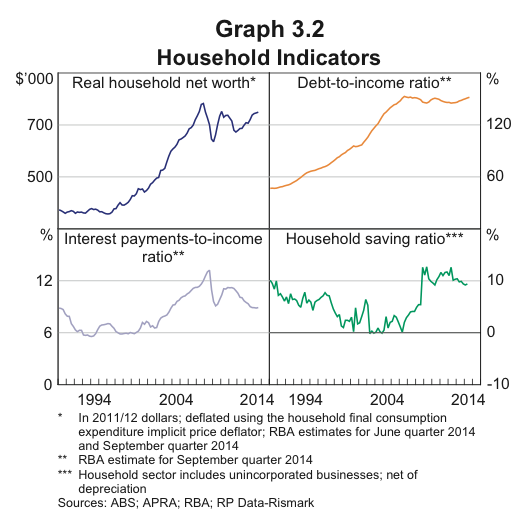
Moreover, there are considerations regarding property that go beyond the threat to financial stability. Australia is in the grip of the most serious downturn in national disposable income in at least three decades, perhaps much longer. The household debt-to-income ratio is stable but high (having risen slightly in the past couple of years). This situation can easily deteriorate as incomes fall, however, either through loss of purchasing power if the nominal exchange rate keeps falling, or rising unemployment if it does not. So it ought not to be too controversial to highlight that it’s undesirable to have a seriously stretched residential housing market at this point in our economic cycle

Macpru is therefore an eminently sensible option. If it totally fails, and if the housing market continues to march inexorably higher, then we may have to countenance higher rates. But the hurdle is very high for higher rates, since as I have mentioned a number of times, nothing else aside from the speculative end of the property market argues for them.

Bounce in steel, iron ore to end the week

Better news in the steel-ore complex today, with futures up in China; a welcome end to another dour week.

Ugliest of all this week was news that growth in crude Chinese steel consumption in has ground a halt this year, for the first time since 2000. The mantra in the iron ore industry is that the 2014 rout has been a supply-side phenomenon; demand is fine. However, the assumption driving higher iron ore output was that Chinese steel consumption had much further to rise. So flat steel consumption, and therefore relatively weak growth in seaborne iron ore demand, is what has made the iron ore supply ramp-up into a problem.

Unless spot stages an almighty rally today, this will mark the 7th straight week of declines. China’s National Day ‘Golden Week’ holidays begin on Wednesday, running to the following Tuesday. There’s a fair chance we see a bit of restocking activity once that’s out of the way, but unless the government the signals a meaningful shift in policy that will reinvigorate demand for steel, the Q4 rebound is likely to be underwhelming this year.

Friday Muzak 

Because econ can wear you down after a while…

Straya T’day 25/9/2014

Cheer up!

John Edwards, a member of RBA board, today delivered a pointed rebuttal to the doom-mongers talking down the economy. (We have nothing to fear but fear itself, my friends!)

The gist is:

The boom was not as big as is widely thought; it has on the whole been sensibly handled; and in any case it is not yet over.

Edwards has of course never heard of Strayanomics, but his arguments are recognizable in their opposition to most of what has been written on this site in its brief history.

The gist of Strayanomics:

The boom was very big, the biggest in Australia’s history; it has not been handled in anything like an ideal fashion; it will, of course, not end overnight, but it is unequivocally in the process of ending.

Readers are at liberty to explore my reasons for these positions on the blog. Or they could turn to the RBA itself, since, as Leith van Onselen of Macrobusiness noted in his takedown of ‘Mr Rainbow’ this morning, the RBA’s own research contradicts Edwards’ message.

No sense of occasion 

Displaying scant regard for the timing of Edwards’ feel-good riposte to the merchants of doom, the slide in steel and iron ore futures continued on its merry way today. Here’s the daily piece from Reuters. No sign of a turnaround yet.

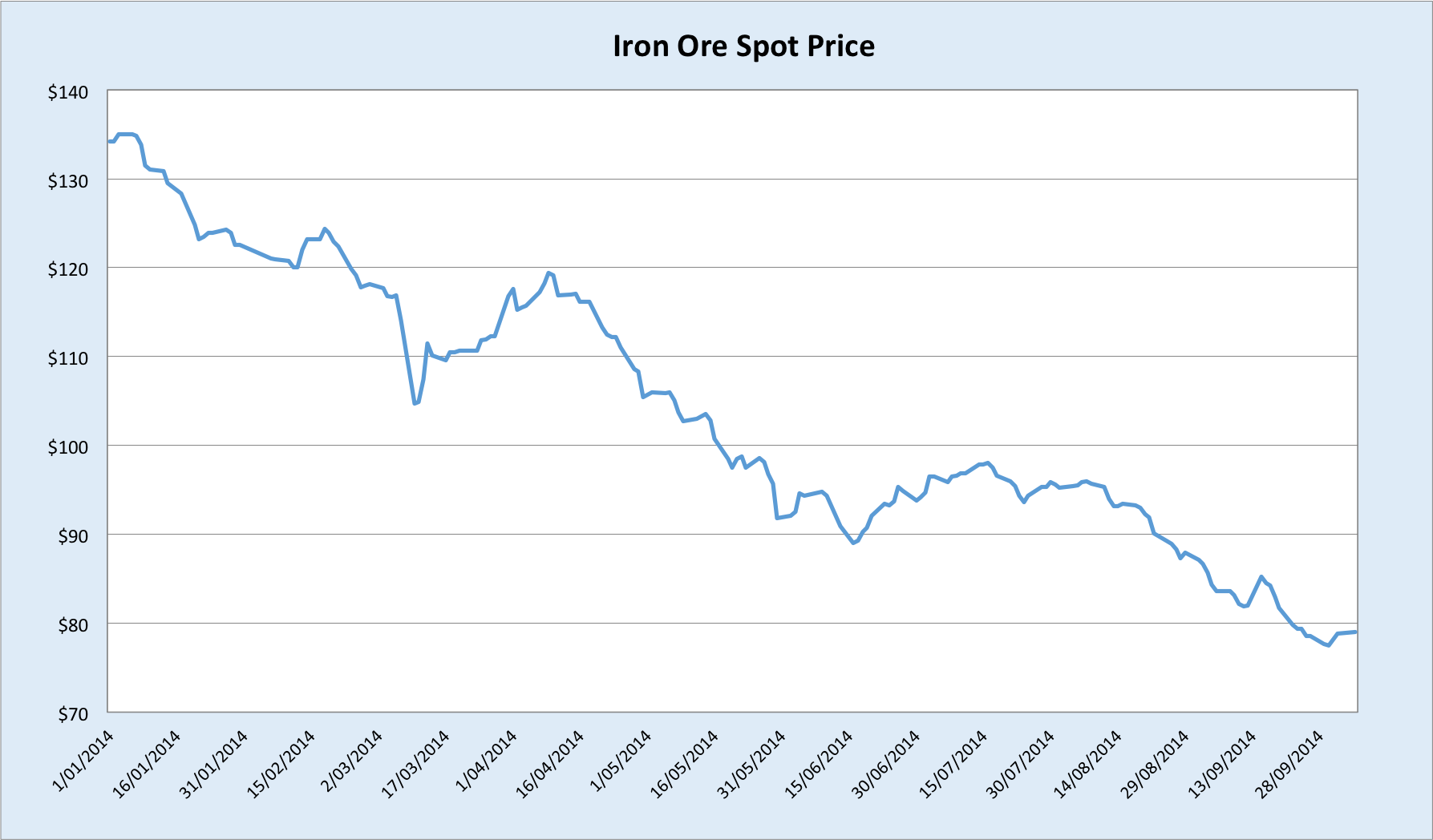
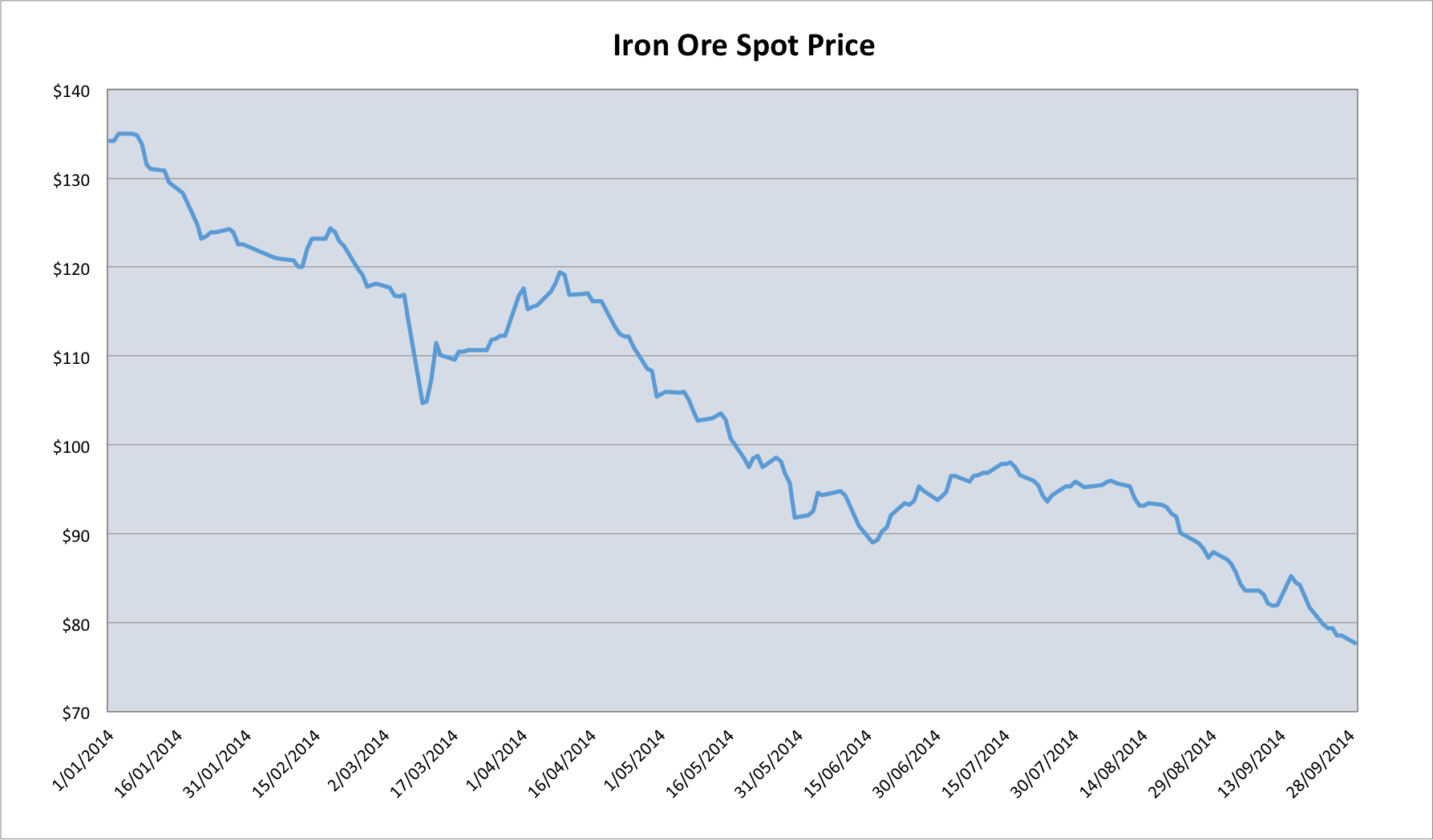
And here’s what spot looks like.

IO-2014

As I never tire of repeating, Australia’s immediate economic fortunes are massively dependent on the decisions taken by a few men in Beijing. If the Chinese leadership presses ahead with reform efforts, more pain lies ahead. If they baulk at the task and revert back to fixed asset investment and loose credit, we’ll enjoy a reprieve. (But note that in due course the pain will eventually arrive; credit booms are inherently unstable, the longer they run, the more tottering they become.)

As such, any indication of wavering resolve is cause for excitement. There was one such indication yesterday when the Wall Street Journal reported that pressure was mounting to replace the reform-minded chief of the People’s Bank of China (China’s central bank). If true, it could usher in a more accommodative monetary policy stance, which should support China’s economy and its demand for raw materials. The PBoC has denied this, for what’s worth, but the situation should be watched closely.

Chinese stocks greeted the news with some enthusiasm, however sadly the same cannot be said of the steel and iron ore.

On steel, Bloomberg has a fascinating story today which provides a neat follow-on from a point I made earlier in the week. The September HSBC PMI showed considerable buoyancy in exports, which I suggested may partially reflect the accelarating offloading of unwanted steel products on to global markets by Chinese mills, which seems to be gathering speed as domestic prices collapse.

From Bloomies:

After the Chinese steel industry expanded by 50 percent since 2010 to keep up with surging demand, mills can produce 210 million metric tons more than the market needs and a quarter of capacity sits idle, according to data compiled by Bloomberg Intelligence. With economic growth slowing, producers are reluctant to close plants, forcing a record pace of sales overseas, where competitors accuse China of dumping.

China, which produces almost half the world’s steel, shipped 52.4 million tons in the first eight months of this year, up 36 percent from a year earlier and more than the 42.5 million exported over the same period in 2007, when sales were at an all-time high, government data show. By year-end, the 2014 total may reach 85 million tons, according to Hu Yanping, an analyst at custeel.com, a researcher in Beijing. That’s 44 percent more than the 2007 record of 59 million tons.

More of the surplus is heading to other countries. In the U.S., the sixth-largest buyer of Chinese steel, hot-rolled coil imports cost about $683 a ton on Sept. 19, the most since June 2012, according to data from Metal Bulletin. That compares with $487.50 for Chinese hot rolled coil exported on a free-on-board basis, the lowest since November 2009, the data show. The premium of about $196 is the biggest since December 2008.

As the premium collapses, the calls for protection from Chinese imports will grow louder, and rightly so. What is left of the US steel industry has no obligation to bail out beleaguered Chinese mills who’ve wrecked their margins after years of capacity over-investment.

As the article notes:

The country won’t be able to increase exports next year “without encountering resistance,” said Shi Shengwu, a manager at the international trade unit of Wuhan Iron & Steel Co., a producer based in Wuhan. “It’s a very touchy issue.”

Indeed. China is set to produce a bit above 800 million tonnes of steel this year. Australia’s iron ore expansions have been undertaken on the assumption that this rises to a billion tonnes by 2020. As it stands, this looks very unlikely to transpire without absolutely eviscerating the world price (forcing some production to idle and therefore preventing the increase in output).

Deficit yawns

The Final Budget Outcome for 2013-2014 is out and showed a substantial deterioration from 2012-2013, roughly in line with the government’s expectations in May. Unfortunately, although the iron ore price slid throughout the last half of FY2014, it is looking like being much lower this coming financial year (see above spot price chart), setting Hockey up for an even worse 2014-2015 budget. Those who thought the Treasurer was low-balling forecasts to engineer a unexpected improvement will be disappointed (for instance).

Still, they’ll always have John Edwards to turn to if things get really glum.

RBA gets onboard the macpru train

The RBA released its biannual Financial Stability Review yesterday, offering the usual trove of insight to anyone interested in such troves.

One big takeaway is that the central bank is now unambiguously acknowledging the dangers emanating from the housing market (which I’ve covered in the series on interest rates):

The low interest rate environment and, more recently, strong price competition among lenders have translated into a strong pick-up in growth in lending for investor housing – noticeably more so than for owner-occupier housing or businesses. Recent housing price growth seems to have encouraged further investor activity. As a result, the composition of housing and mortgage markets is becoming unbalanced, with new lending to investors being out of proportion to rental housing’s share of the housing stock.

If we jump to the Australian Financial System section, the RBA had the following to say:

Australian banks are benefiting from improved wholesale funding conditions globally and, in turn, an easing in overall deposit market competition. Lower funding costs are facilitating strong price competition in housing and commercial property lending. Fast growth in property prices and investor activity has increased property-related risks to the macroeconomy. It is important for macroeconomic and financial stability that banks set their risk appetite and lending standards at least in line with current best practice, and take into account system-wide risks in property markets in their lending decisions. Over the past year APRA has increased the intensity of its supervision around housing market risks facing banks, and is currently consulting on new guidance for sound risk management practices in housing lending.

And again in the section on Household and Business Finances:

The pick-up in household risk appetite that was evident six months ago appears to have continued, as has the associated willingness to take on some types of debt. Housing prices have been rising strongly in the larger cities. To some extent, these outcomes are to be expected given the low interest rate environment and the search for yield behaviour of investors more generally, both here and overseas. However, the composition of housing and mortgage markets is becoming unbalanced.

Nervous about housing and laying much of the blame at its own feet (low interest rates). As I’ve said a number times, the robust housing sector is the one area of the economy that argues for higher rates, whereas slumping commodity prices, the wind-down in mining investment and weak domestic demand generally all argue for lower.

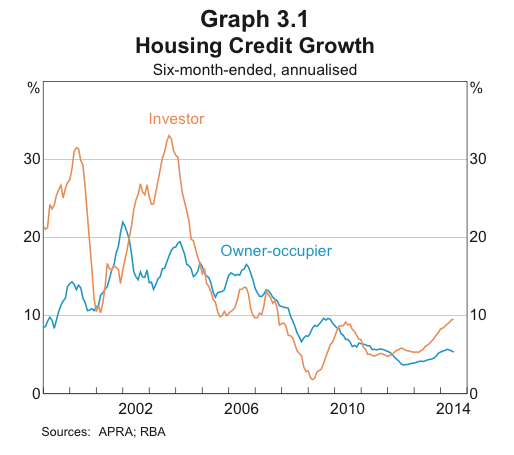
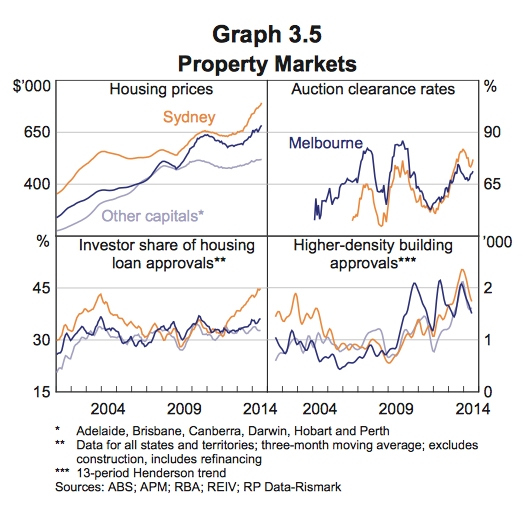
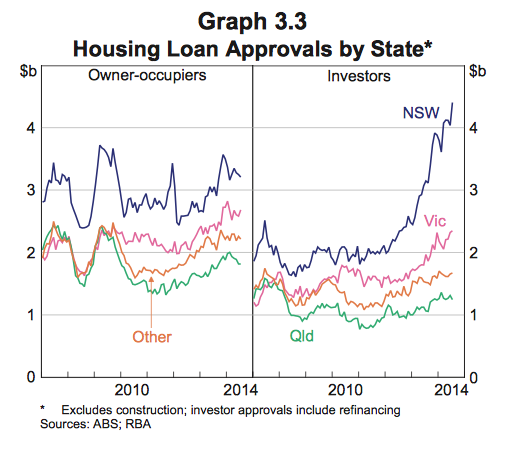
A look through the Review’s charts helps elucidate the situation in housing.

Screen Shot 2014-09-25 at 1.57.50 pm

Screen Shot 2014-09-25 at 1.58.13 pm

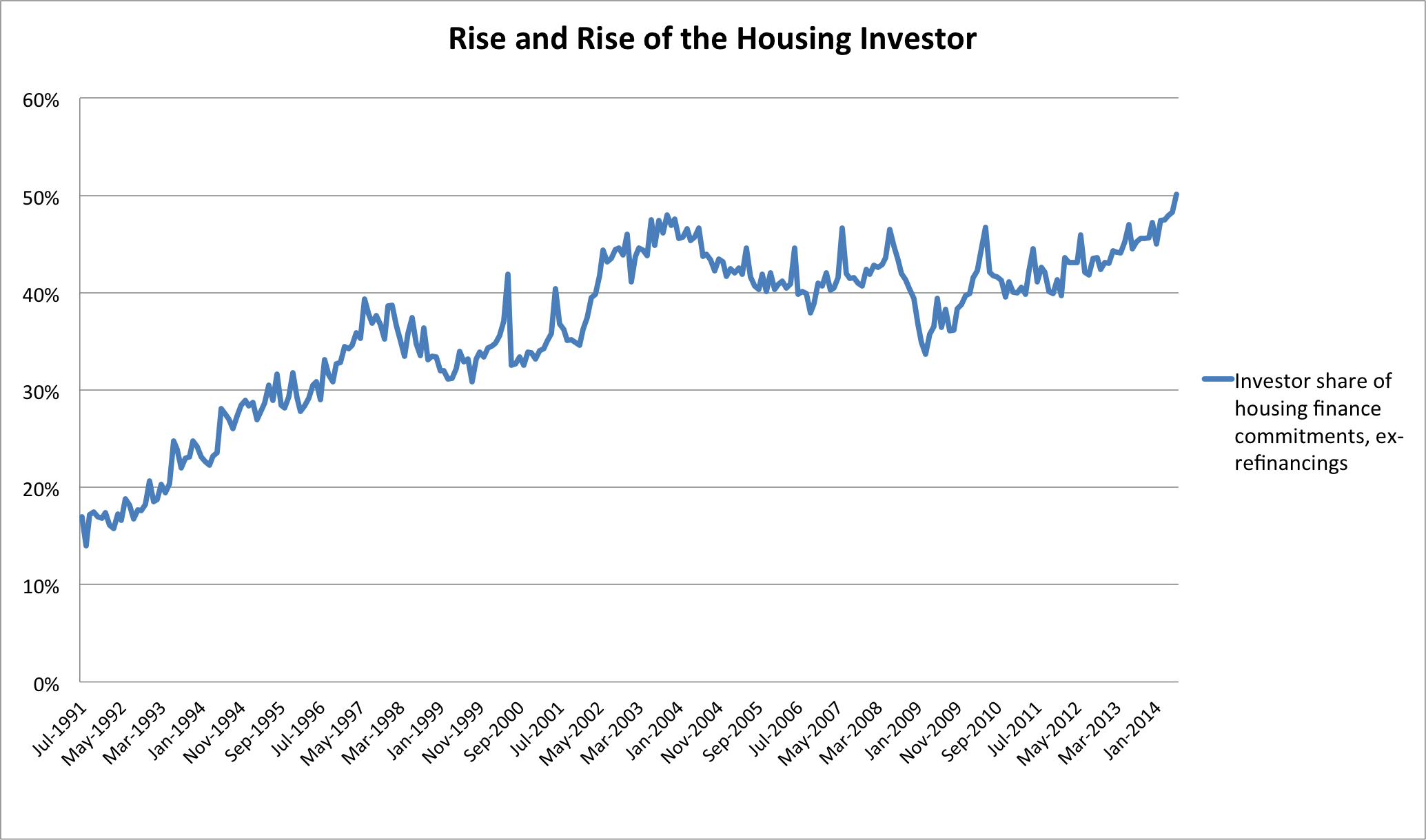
I have previously discussed the property investment frenzy which took hold in the early years of the millennium, and this is clearly visible in the above charts (note the investor share of housing loan approvals includes refinancing in that chart, my own chart did not). Indeed, by the standards of 2003-04, the current run-up in investor borrowings looks paltry. However, it must be remembered that we began from a much higher base in 2013. Moreover, the national figures mask the fact that the current boom has been centred on Melbourne and Sydney, with the latter easily accounting for the most fevered activity. This we can observe in both the pace of house price appreciation in Sydney (above) and the parabolic explosion in investor loan approvals (below).

Screen Shot 2014-09-25 at 1.58.06 pm

The RBA believes the primary threat this poses is to real macroeconomic conditions, rather than to the stability of the financial system (which would exacerbate the damage the macroeconomy, of course). For now, I think this is a fair assessment, since we haven’t seen the kind of deterioration in lending standards that usually characterises bubbles that go on to destabilise financial systems (though this is heavily dependent on how serious the terms of trade downturn gets). The adverse impact of falling prices on lenders occurs when loans repayments become impaired; house prices can fall without borrowers necessarily defaulting, provided they have sufficient net worth to weather the capital loss on property assets. Low net worth buyers are simply being priced out of the market, so the argument goes, and therefore we don’t need to worry about surging non-performing loans in the event of a property downturn.

Nevertheless, Australian households remain highly indebted, and the debt-to-income ratio is exposed to a shock to incomes arising from the falling terms of trade and resource-sector investment. So even if the banking system doesn’t suffer systemic instability, there is still scope for the housing market to hit consumer spending.

Screen Shot 2014-09-25 at 1.57.58 pm

To my mind, the issue is that housing risks inflicting a wealth shock on Australian households at the same time that they experience an income shock due to the unwinding of the twin booms in the terms of trade and resource-sector investment. Households exhibit measurable propensities spend out of their current income, which is hardly surprising, but spending patterns also react to changes in wealth. By allowing house prices to appreciate as they have, policymakers added another unwanted risk to the economy as it enters the post-boom adjustment.

What to do?

If the housing boom was primarily a response to low interest rates, and if little else in the economy argues for higher rates aside from booming housing, then the RBA is plainly in a bind. The economy would be suffering grievously today if the RBA hadn’t reduced the cash rate over the period it did (late 2011 to late 2013), but it now has a disconcerting housing boom on its hands as a result.

As it turns out, this is a widespread dilemma which many developed economies have had to contend with in recent years. Largely due to structural changes in the global economy, over the past decade and a half, many developed economies have faced low inflation and weakening labour markets (especially amongst low-skilled workers). The popular prescription to this problem was to lower interest rates. As it turned out, lower interest rates exhibited a tendency to drive credit growth and asset prices higher, to a much greater extent than goods and services inflation. This was a challenge to orthodox thinking on economic policy.

A suite of policy tools have therefore been gaining popularity since the GFC as a way of addressing this conundrum. Known as macroprudential regulations, these tools are aimed at curtailing the speculative excesses that tend to appear when interest rates are low, thus avoiding the need to hike interest rates in environments that would otherwise not warrant them. The Economist has a useful primer on macroprudential policies.

The RBNZ introduced macpru policies last year, chiefly restrictions on high loan-to-valuation residential mortgages, and this seems to be having the desired effect. After vocal calls for the RBA to adopt (through APRA) a similar approach in tandem with its cuts to interest rates, we are finally seeing some receptiveness on the Bank’s part. I have highlighted the relevant comment from the Review, which strongly suggests regulators are preparing to introduce these policies.

Then, early this afternoon, we received virtual confirmation that the RBA will push ahead with macpru controls to address the investor segment of the property market. This is a most welcome development and sensible policy. Stevens is correct that there is little downside to experimenting with these policy options, which was always one of the foremost points of recommendation.

The AUDUSD was hammered on Stevens’ remarks; the FX market knows as well as I do that the investor property boom is the chief factor holding up interest rates!

AUDTSvenes

Straya T’day 23/9/2014 (updated)

HSBC flash PMI firms

The HSBC flash PMI for September was released this morning and showed a slight bounce, coming in at 50.5 on expectations of a flat 50, from 50.2 last month. Full report.

Key themes:

  • Exports are leading the charge
  • Prices continue to ease as deflationary impulses arising from severe overcapacity exert themselves
  • Employment exhibiting a slightly worrying trend (bearing in mind the relatively narrow scope of this survey)

This survey is broadly in tune with the trends prevailing in the Chinese economy at present. These are; ongoing structural adjustment of growth patterns, a property sector shakeout, and abating price pressures in industries suffering overcapacity, especially those tied to the property sector (i.e. steel).

Without knowing precisely what is driving rising export orders in this survey, it is reasonable to surmise a significant contribution from steel exports (improving US demand for consumer goods is likely the other main factor). The most recent reading on the steel industry showed weakening domestic demand, partially offset by surging exports. Chinese steel products are becoming the solar panels of previous years, with sizeable excess supply being dumped into global markets after years of over-investment in new capacity. This process looks to be accelerating sharply now owing to weak domestic demand. We have already seen signs that foreign governments will not tolerate this indefinitely. With steel prices still sliding (the most-traded rebar contract was down again this morning, despite the PMI), the tidal wave of steel hitting global markets is unlikely to slow any time soon. It will be very interesting to see how long it takes for an international backlash to turn China’s excess supply back on to itself.

The situation in the steel market is a neat microcosm of the broader state of the Chinese economy. When the GFC hit, China switched its primary source of final demand from foreign consumption demand to domestic investment demand. Without external surpluses, China had to flood its economy with credit to facilitate extremely high investment levels. Now that China is approaching the limits of this growth model (willingly, for now, but note that the adjustment would have been forced upon it eventually had the government persevered with debt-funded investment spending), any help it can get from external consumption demand would lessen the slowdown it must endure as it rebalances its economy. In other words, trade surpluses will help China ‘grow out’ of its debt burden. The question is, Are other countries able and willing to run the corresponding deficits to enable China to pursue this policy? A USD bull market means the US could assume the role of international debtor nation, but whether it is foolish enough to adopt that model again, so soon after it proved so ruinous, is a question I would rather not speculate on.

Anyway, for now Aussie markets are enjoying some much-needed relief courtesy of the better-than-expected data, which isn’t especially surprising since both equities and the currency looked oversold on a short-term basis.

ASX200daily

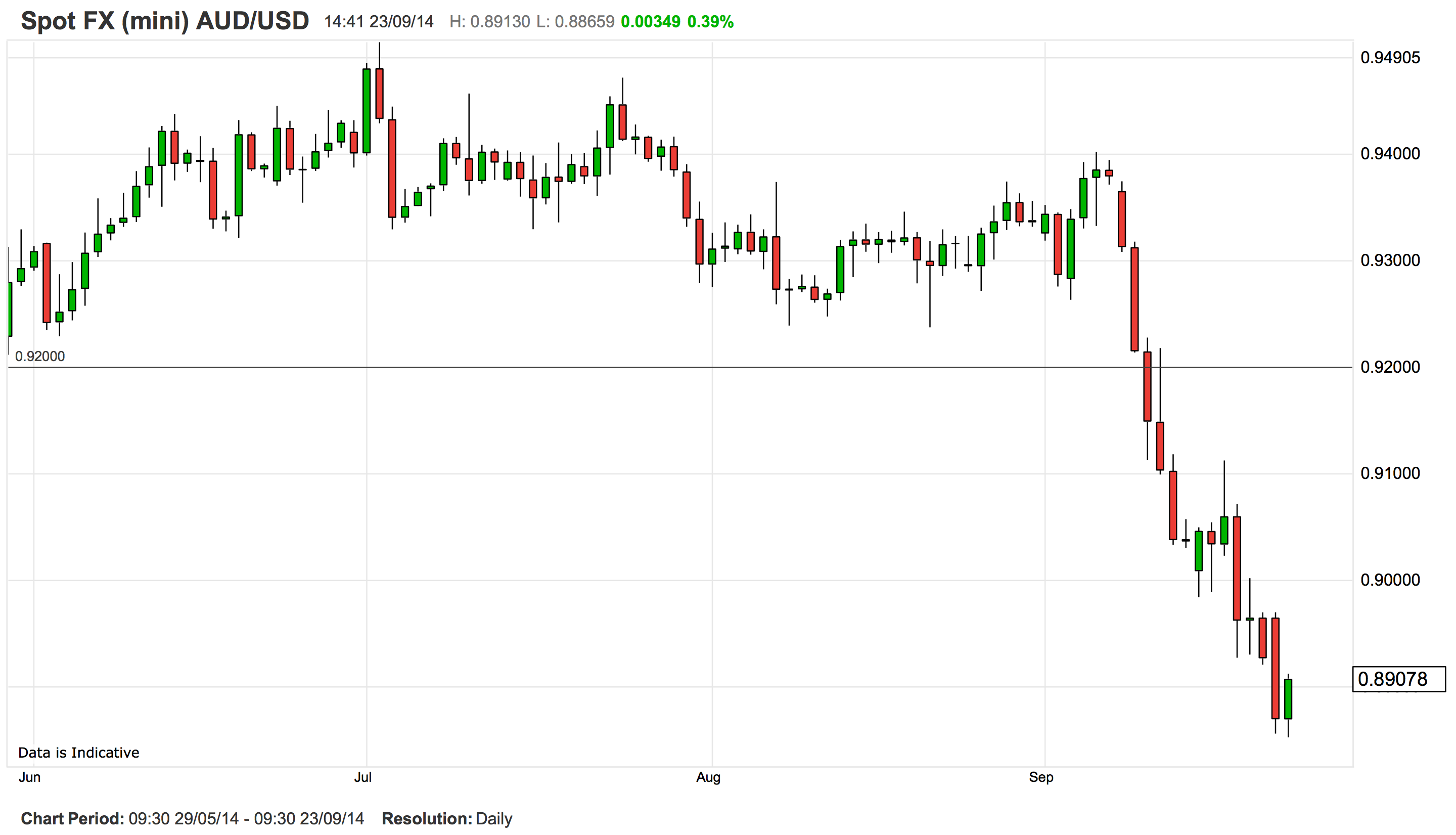
AUD 23:9chart

Update 1

No relief for steel or iron ore futures today, despite the PMI lift. More at the usual place.

SPI futures and the AUDUSD are giving up their gains accordingly, though sagging European growth prospects are certainly weighing on equities markets generally this evening.

Yesterday I mentioned the horror show that is the WA budget, which has become reliant on frankly ridiculous forecasts for iron ore prices. Today we finally received an admission from the Treasurer that current prices are starting to fray nerves in the West. Gone are the days of WA’s GST largesse being redistributed to the laggard states of the Federation. This is not good news for my home state of South Australia, which is grappling with its own budget mess. As an aside, the current government may blame the industrial composition of the state for its economic travails, but it certainly cannot blame the Federal government for its public finance issues. The ALP has been in power in SA since 2002, it has had ample time to address the weaknesses of the economy. Instead it came to rely far too heavily on the promise of Olympic Dam, to the detriment of its own budget position.